• Home
  • IMMAs
    • IMMA Selection Criteria
    • IMMA Identification Process
    • IMMA definitions
    • FAQ on IMMAs
    • IMMA citations
    • Regional IMMA workshops
      • Mediterranean Sea
      • Pacific Islands
      • North East Indian Ocean and South East Asian Seas
      • Extended Southern Ocean
      • Western Indian Ocean and Arabian Seas
      • Australia-New Zealand and South East Indian Ocean
      • Black Sea, Turkish Straits System and Caspian Sea
      • South East Tropical and Temperate Pacific Ocean
      • South West Atlantic Ocean Region
      • North East Atlantic Ocean Region
      • North West Atlantic Ocean and Wider Caribbean
    • Current IMMAs Summary
    • IMMAs Searchable Database
    • IMMAs Description and Fact Sheets
    • IMMA Spatial Layer Download
    • Regional Groups
    • How can IMMAs be used?
  • IMMA e-Atlas
  • IMMA Specialist Group
    • Mission
    • Task Force Members
    • Supporting organisations
    • Partner organisations
    • Activities
      • Panorama Solutions
      • Geospatial Genetics to Identify IMMAs
      • Geospatial Analysis of Threats
    • ICMMPA
  • Resources
    • Documents
    • IMMA Handbook
    • IMMA citations guidance
    • IMMA Spatial Layer Download
    • IMMA – Area Submission
  • Contacts
  • News
  • Menu Menu

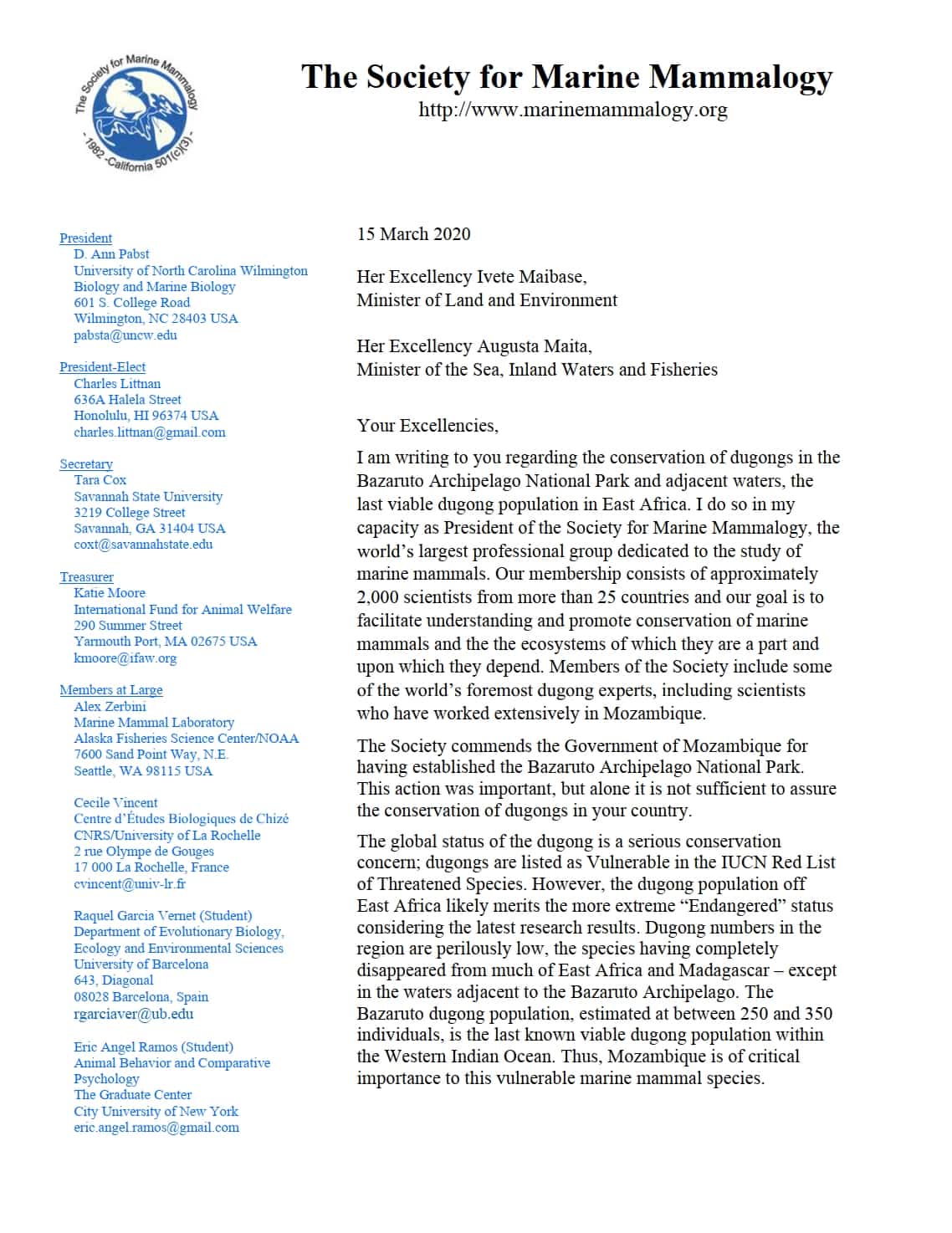
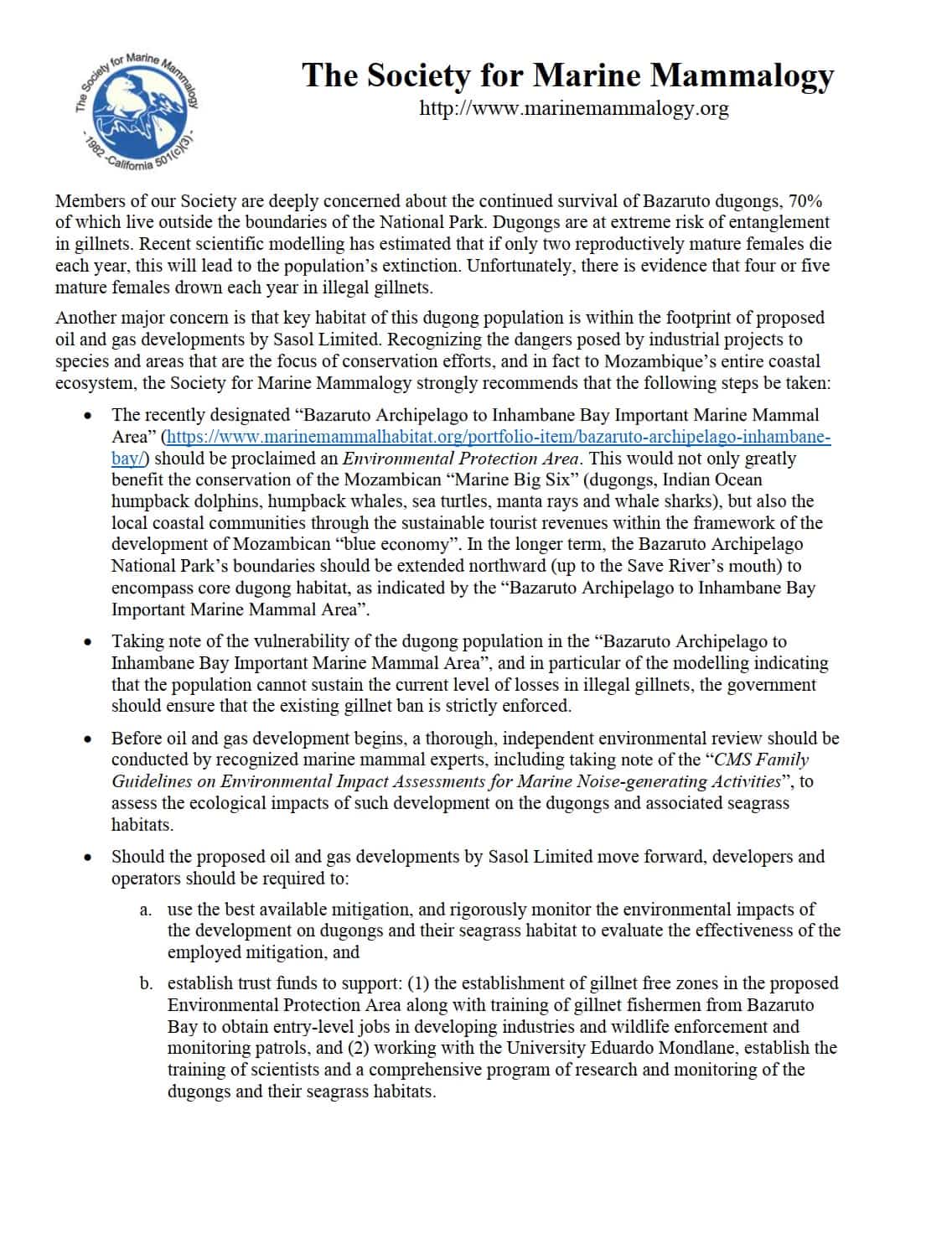
Letter from the Society for Marine Mammalogy to protect dugong stronghold in Mozambique

17 March 2020. The President of the Society for Marine Mammalogy—representing 2,000 scientists from 25 countries—has taken the extraordinary step of writing to high government officials in Mozambique advising strong further protection for the last viable dugong population in East Africa.

While commending the government for the Bazaruto Archipelago National Park which covers 30% of the 250-350 dugongs left, the President strongly recommended that the recently identified Bazaruto Archipelago to Inhambane Bay Important Marine Mammal Area (IMMA) should become an Environmental Protection Area. That would protect almost all the dugongs—as well as Indian Ocean humpback dolphins, humpback whales, sea turtles, manta rays and whale sharks—and serve to benefit local communities as part of Mozambique’s drive for a blue economy.

The full text of the letter (which follows below) advises removal of illegal gillnets, re-consideration of oil and gas developments and other necessary steps to achieve protected habitat and a successful outcome. The IUCN Marine Mammal Protected Areas Task Force fully supports this initiative and the letter from the SMM President.
Categories

Older news

Privacy Policy Cookie Policy
This website runs on green hosting - verified by thegreenwebfoundation.org

Partners

IUCN World Commission on Protected Areas (WCPA)
IUCN Species Survival Commission (SSC)
International Committee on Marine Mammal Protected Areas (ICMMPA)
Tethys Research Institute
Whale and Dolphin Conservation (WDC)
Global Ocean Biodiversity Initiative (GOBI)
Office français de la biodiversité

Follow us

@copyright 2016-2020 - Marine Mammal Protected Areas Task Force - Web Design: Elena Politi - Graphic: Massimo Demma
Link to: Forty five candidate IMMAs identified around Australia and New Zealand Link to: Forty five candidate IMMAs identified around Australia and New Zealand Forty five candidate IMMAs identified around Australia and New Zealand Link to: 13 Important Marine Mammal Areas approved in the Southern Ocean: one of the world’s richest marine mammal areas Link to: 13 Important Marine Mammal Areas approved in the Southern Ocean: one of the world’s richest marine mammal areas 13 Important Marine Mammal Areas approved in the Southern Ocean: one of the...
Scroll to top

Loading...