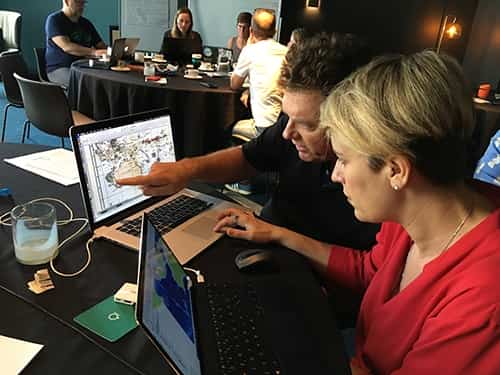
19th February 2020. Last week, 10th-14th February, the IUCN Marine Mammal Protected Areas Task Force (the “Task Force”) completed the sixth Important Marine Mammal Area workshop in Perth, Western Australia. The intensive workshop hosted 31 marine mammal scientists and observers from 6 countries to map the important habitats for marine mammals in the waters of Australia, New Zealand and the South East Indian Ocean.
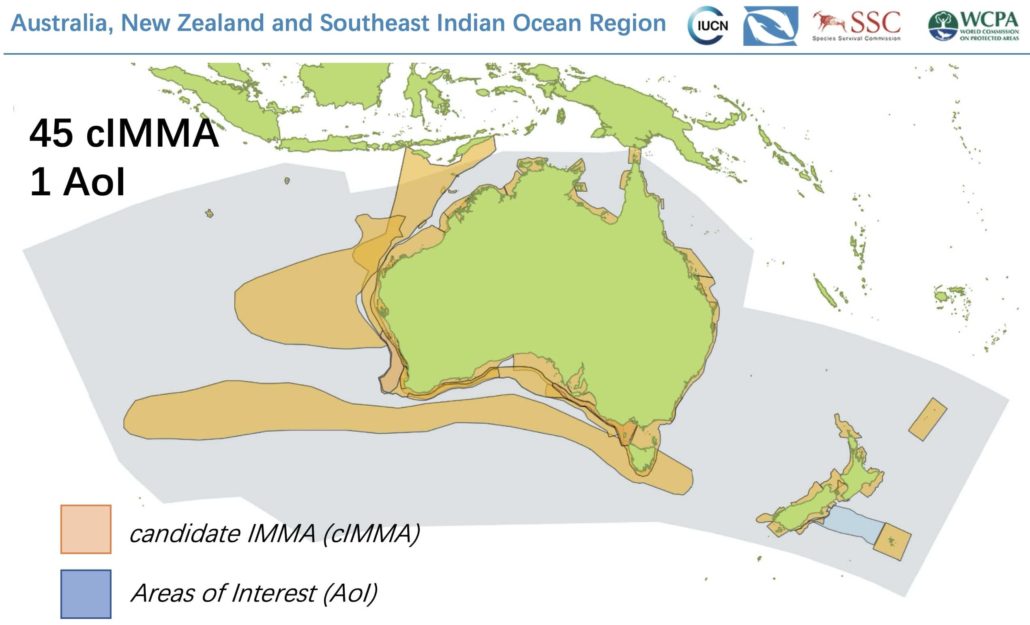
An impressive total of 45 candidate important marine mammal areas, or cIMMAs, were identified, along with 1 area of interest (AoI) which will be retained as a potential future IMMA pending further research. A total of 14 cIMMAs are in New Zealand waters, and 31 in Australian waters. Several of the cIMMAs extend well into offshore high seas, outside of the 200 nautical mile exclusive economic zone.
“These are among the best documented candidate IMMAs that we’ve had to date,” said Task Force co-chair Giuseppe Notarbartolo di Sciara.
“The areas nominated,” added co-chair Erich Hoyt, “feature nearshore habitat for most of the world’s remaining dugong; Australian humpback and snubfin dolphins, only recently recognised as species; as well as deep canyons with vulnerable sperm, pygmy sperm whales, and endangered blue and pygmy blue whales.”
Also living in Australia and covered by the cIMMA proposals are two species of bottlenose dolphins and the endangered Australian sea lion. New Zealand has the world’s only population of the endangered Hector’s dolphin as well as its subspecies Maui dolphin, and many rare beaked whale species.
The Perth workshop follows successful Task Force IMMA regional workshops in the Mediterranean, Pacific Islands, Northeast Indian Ocean-Southeast Asian Seas, the Extended Southern Ocean, and the Western Indian Ocean-Arabian Seas in 2016-2019. The 45 candidate IMMAs stands as the second highest total to date for a single region.
Important Marine Mammal Areas—IMMAs—are defined as discrete portions of habitat, important to marine mammal species. These areas have the potential to be delineated and managed for conservation. They are not marine protected areas but layers that can be used in spatial planning or for other area-based management tools.
The candidate IMMAs now go to an independent review panel. If approved, they will be placed on the IMMA e-Atlas, and can be used for conservation planning. Those without sufficient evidence will remain as cIMMAs or revert to AoI. Final results from the panel are expected to be posted online later in 2020. The collective expertise, energy and commitment of the scientists gathered in Perth have made this technical and scientific exercise a great success.
In addition to the cIMMAs identified, potentially 25 of the cIMMAs may qualify as IUCN key biodiversity areas (KBAs). KBAs are a parallel process for identifying areas of international importance in terms of biodiversity conservation for all species using globally standardised criteria.
The Task Force has adopted as its mandate the mapping of habitats for the 130 species of marine mammals—cetaceans, pinnipeds, sirenians, otters and the polar bear—across the world ocean. The work has been largely sponsored by the Global Ocean Biodiversity Initiative through the German Government’s International Climate Initiative (GOBI-IKI), with substantial contributions from the French Biodiversity Agency, MAVA Foundation, Whale and Dolphin Conservation and Tethys Research Institute.