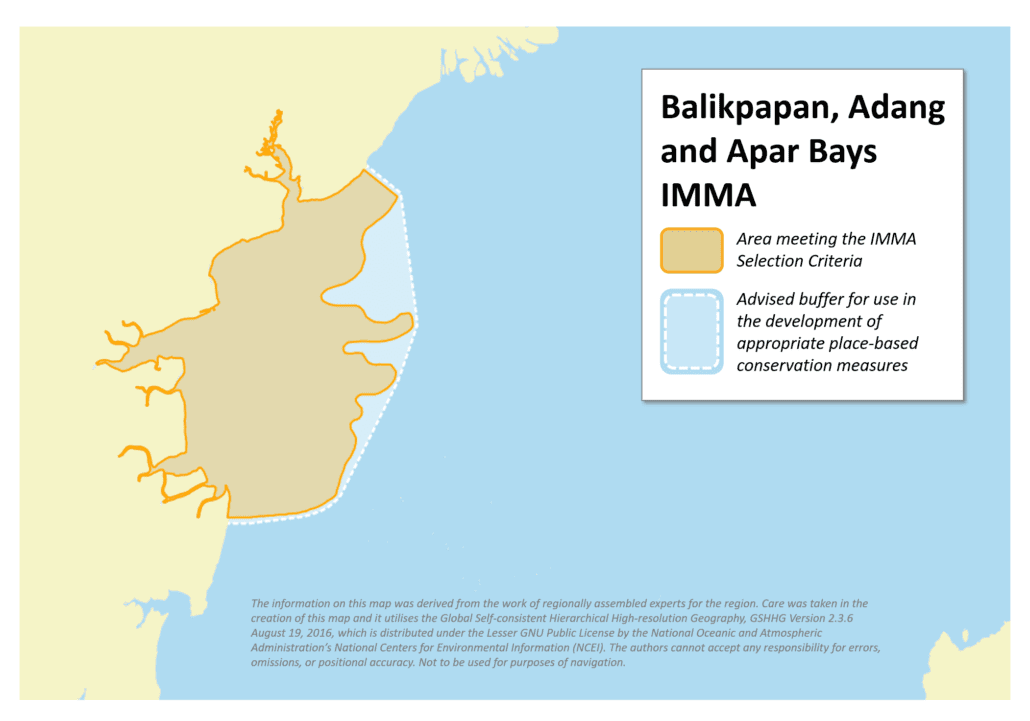
Size in Square Kilometres
6285
Qualifying Species and Criteria
Irrawaddy dolphin – Orcaella brevirostris
Criterion A; B (1); C (1); D (1)
Dugong – Dugong dugon
Criterion A; B (1); C (2)
Criterion D (2) – Marine Mammal Diversity
Other Marine Mammal Species Documented
Neophocaena phocaenoides, Tursiops aduncus
Summary
Balikpapan, Adang and Apar bays in East Kalimantan, Indonesia provide core habitat for Endangered Irrawaddy dolphins (Orcaella brevirostris), Vulnerable dugongs (Dugong dugon) and finless porpoises (Neophocaena phocaenoides) and Near Threatened Indo-Pacific bottlenose dolphins (Tursiops aduncus). Irrawaddy dolphins and dugongs mostly occupy the inner bay areas, while finless porpoises and Indo-Pacific bottlenose dolphins occur in the river mouths and near shore waters of each bay. All three bays serve as feeding, mating, calving and nursing areas for Irrawaddy dolphins. Genetic samples collected from Irrawaddy dolphins in Balikpapan Bay contained a unique haplotype, and demonstrated the population’s genetic divergence from other sampled South(east) Asian populations. Within the IMMA, population estimates are only available for the Irrawaddy dolphin population in Balikpapan Bay, and the best and most recent estimate in 2015 is 73 individuals from mark-recapture analyses. The population demonstrated high site-fidelity with up to 54% of individually identified dolphins being re-sighted at least once between survey years. The dugong population in Balikpapan Bay was estimated at roughly 12 individuals.
Description of Qualifying Criteria
Criterion A – Species or Population Vulnerability
Irrawaddy dolphins (Orcaella brevirostris) are listed as Endangered on the IUCN Red List and a decline in the population in Balikpapan Bay was noted between 2000 and 2015 (Kreb et al. 2020). Dugongs (Dugong Dugon) are listed as vulnerable on the IUCN Red List. Based on interviews and direct observations, dugongs in Balikpapan Bay are increasingly rarely observed.
Criterion B – Distribution and Abundance
Sub-criterion B1 – Small and Resident Populations
Locally occurring populations of Irrawaddy dolphin are often small and occupy small areas in relation to the species’ total global population. In Balikpapan Bay, a shift in their distribution was observed with increased dependency on the upstream part and rivers of the bay. Criterion Bi also applies to the Dugong locally occurring population within the area, which is estimated to only number about 12 individuals (de Bruyn, 2002). These animals are dependent on the availability of increasingly decreasing sizes of seagrass meadows based in interview surveys (Kreb et al. 2020).
Sub-criterion B2 – Aggregations
Criterion C: Key Life Cycle Activities
Sub-criterion C1 – Reproductive Areas
The locally occurring population of Irrawaddy dolphins uses Balikpapan Bay for breeding and as nursing areas (Kreb, 2004, Kreb et al. 2020). Mating behaviour has been observed as well as neonates and young calves within groups. A neonate dugong calf was observed by de Bruijn (2002) and another one found stranded and reported in 2015 by the District Fisheries Service.
Sub-criterion C2: Feeding Areas
Dugong feeding trails have also been observed and several seagrass meadows were found inside the bay. Seagrass has also been described by local informants (fishermen) for Adang and Apar Bays.
Sub-criterion C3: Migration Routes
C3a – Whale Seasonal Migratory Route
C3b – Migration / Movement Area
Criterion D – Special Attributes
Sub-criterion D1 – Distinctiveness
Mitochondrial DNA collected from Irrawaddy dolphins in Balikpapan Bay showed a genetic divergence from other South(east) Asian specimens with a unique haplotype for Balikpapan Bay (Yusmalinda et al. 2017).
Sub-criterion D2 – Diversity
Supporting Information
Budiono. 2003. Studi keberadaan duyung (Dugong dugon, Müller) di Teluk Balikpapan (Study of the occurrence of dugongs (Dugong dugong, Müller) in Balikpapan Bay). Final report issued by Yayasan Konservasi RASI for the Gibbon Foundation.
De Bruijn, P. 2002. ‘Population ecology of a recently discovered population of Dugongs (Dugong dugon Müller 1776) and seagrass in Balikpapan Bay, Indonesia’. Master thesis. University of Amsterdam.
Iongh, H.H., Kiswara Wawan Kustiawan, W.E. and Loth, P. 2007. A review of research on the interactions between dugongs (Dugong dugon Muller 1776) and intertidal seagrass beds in Indonesia. Hydrobiologia 591 (1): 73-83. [online] Available at: DOI: 10.1007/s10750-007-0785-4.
Kreb, D. 2004. ‘Facultative river dophins: Conservation and social ecology of freshwater and coastal Irrawaddy dolphins in Indonesia’. PhD thesis. University of Amsterdam, The Netherlands.
Kreb, D. and Rahadi, K.D. 2004. Living under an aquatic freeway: effects of boats on Irrawaddy dolphins (Orcaella brevirostris) in a coastal and riverine environment in Indonesia. Aquatic Mammals, 30: 363–375. [online]. Available at: DOI: 10.1578/AM.30.3.2004.363
Kreb, D. and Budiono, I. 2005. Cetacean Diversity and Habitat Preferences in Tropical Waters of East Kalimantan, Indonesia. The Raffles Bulletin of Zoology 53 (1): 149-155.
Kreb, D. and Lim, I.S. 2009. ‘Balikpapan Bay Irrawaddy dolphin Project 2008. Conservation and diversity of cetaceans in and near Balikpapan Bay, East Kalimantan, Indonesia’. Final Technical Report.
Kreb D,, Lhota S,, Porter L,, Redman A., Susanti I, and Lazecky, M. 2020. Long-term population and distribution dynamics of an endangered Irrawaddy Dolphin population in Balikpapan Bay, Indonesia in response to coastal development. Frontiers in Marine Science 7: 533197. http://doi.org/10.3389/fmars.2020.533197
Yusmalinda, N.L.A., Anggoro, A.W., Suhendro, D.M., Ratha, I.M.J., Suprapti,D., Kreb, D., Cahyani, N.K.D. 2017. Identifikasi jenis pada kejadian Cetacea terdampar di Indonesia dengan teknik molekuler (Species identification of stranded cetaceans in Indonesia revealed by molecular technique). Jurnal Ilmu dan Teknologi KelautanTropis 9 (2): 465-474.[online]. Available at DOI: http://dx.doi.org/10.29244/jitkt.v9i2.19283
Downloads
Download the full account of the Balikpapan, Adang and Apar Bays IMMA using the Brochure button below:
To make a request to download the GIS Layer (geopackage and/or geojson) for the Balikpapan, Adang and Apar Bays IMMA please complete the following Contact Form: