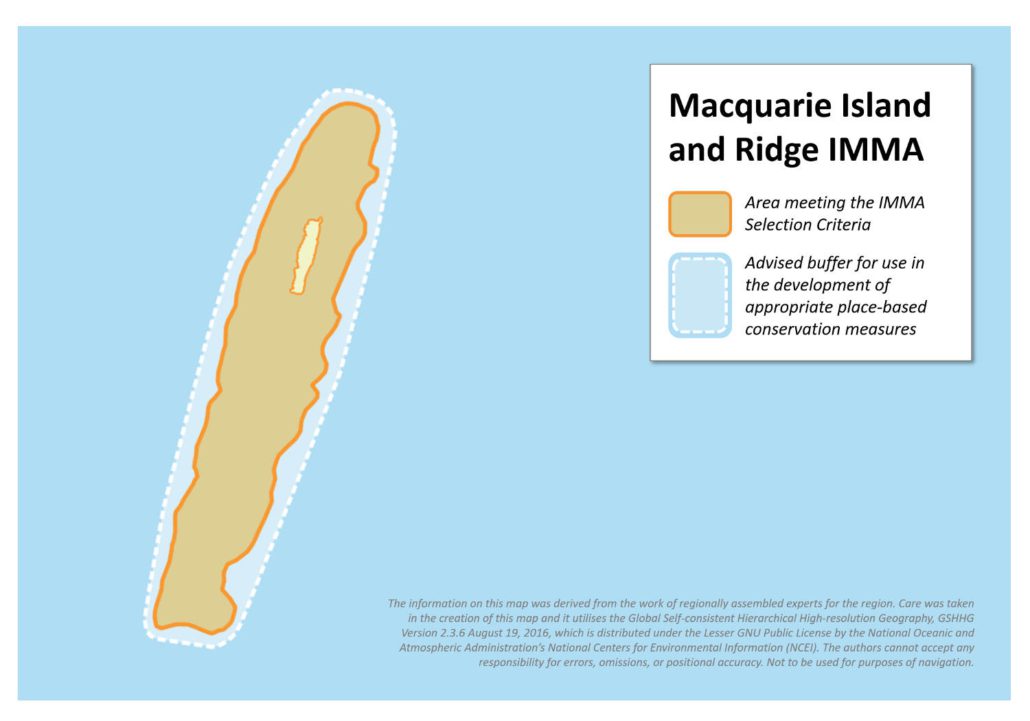
Size in Square Kilometres
11851
Qualifying Species and Criteria
Antarctic fur seal – Arctocephalus gazella
Criterion C (1; 2)
Subantarctic fur seal – Arctocephalus tropicalis
Criterion C (1, 2)
New Zealand fur seal – Arctocephalus forsteri
Criterion C (1, 2)
Southern elephant seal – Mirounga leonina
Criterion C (1)
Killer whale – Orcinus orca
Criterion C (2)
Criterion D (2) – Marine Mammal Diversity
Arctocephalus forsteri, Arctocephalus gazella, Arctocephalus tropicalis, Balaenoptera acutorostrata, Berardius arnuxii, Eubalaena australis, Globicephala melas, Lissodelphis peronii, Megaptera novaeangliae, Mesoplodon bowdoini, Mesoplodon layardii, Mirounga leonina, Orcinus orca, Phocarctos hookeri, Phocoena dioptrica, Physeter macrocephalus, Ziphius cavirostris
Other Marine Mammal Species Documented
Hydrurga leptonyx
Summary
Macquarie Island, which lies half way between Australia and Antarctica, was inscribed on the World Heritage List in 1997, on the basis of its outstanding natural values. The island is unique in that three fur seal species reside on this island, Antarctic (Arctocephalus gazella), subantarctic (A. tropicalis) and New Zealand fur seals (A. forsteri). The island also hosts an important southern elephant seal (Mirounga leonina) breeding colony (~10% global population). However, evidence indicates that this population has been continuously decreasing for the past seven decades at 1.2 % per annum. Leopard seals (Hydrurga leptonyx) and Endangered New Zealand sea lions (Phocarctos hookeri) are vagrants to the island. The IMMA also serves as a seasonal feeding ground for killer whales (Orcinus orca) and many species of cetaceans have been sighted or have stranded around the island, highlighting this region as an area of high marine mammal diversity.
Description of Qualifying Criteria
Criterion A – Species or Population Vulnerability
Criterion B – Distribution and Abundance
Sub-criterion B1 – Small and Resident Populations
Sub-criterion B2 – Aggregations
Criterion C: Key Life Cycle Activities
Sub-criterion C1 – Reproductive Areas
Macquarie Island is a breeding site for three Arctocephalus species (Antarctic (Arctocephalus gazella), sub-Antarctic fur seal (Arctocephalus tropicalis) and New Zealand fur seal (Arctocephalus forsteri)) between November and April each year (Goldsworthy et al. 2008). These populations are recovering slowly following harvesting on the island in the early 1800s (Goldsworthy et al. 2008). The sub-Antarctic fur seal is their only significant breeding site in this region (Threatened Species Scientific Committee 2016a). Southern elephant seals, breed each year from August to October on Macquarie Island (McMahon et al. 2005; Hindell et al. 2017).
Sub-criterion C2: Feeding Areas
Macquarie Island southern elephant seals (Mirounga leonina) and other species are a seasonal prey resource for visiting killer whales (Travers et al. 2018). The region to the north of Macquarie Island, along the Macquarie Ridge, also provides important central place foraging habitat for New Zealand fur seals (Shaughnessy & Goldsworthy, 1993) as well as the nationally endangered sub-Antarctic and Antarctic fur seals breeding on the island (Robinson et al. 2002). Killer whales are regular seasonal visitors to Macquarie Island where they are known to feed on southern elephant seals, fur seals and penguins; sightings peak from October to December (Travers et al. 2018).
Sub-criterion C3: Migration Routes
C3a – Whale Seasonal Migratory Route
C3b – Migration / Movement Area
Criterion D – Special Attributes
Sub-criterion D1 – Distinctiveness
Sub-criterion D2 – Diversity
Four species of pinnipeds breed on Macquarie Island (southern elephant seals and three Arctocephalus spp.), and leopard seals and New Zealand sea lions are vagrants to the island feed in waters surrounding the island (Rounseveld and Eberhard 1980, Robinson et al. 1999). A diverse group of cetacean species have been described from Macquarie Island historically and more recently from sightings and strandings data (Clarke et al. 2017). Commonly recorded cetacean species include long-finned pilot whales, southern right whale dolphins and sperm whales, which can be sighted from the island. Southern right and humpback whales, listed as Endangered in Tasmanian waters, are also known from strandings and sightings data (Clarke et al. 2017). Importantly, the Macquarie Island region supports high beaked whale diversity as evidenced from stranding and skeletal remains of Arnoux’s (Berardius arnuxii), Andrews’(Mesoplodon bowdoini), Blainville’s (Mesoplodon densirostris), strap-toothed (Mesoplodon layardii) and Cuvier’s (Ziphius cavirostris) beaked whales (Clarke et al. 2017).
Supporting Information
Clarke, R. H., Gales, R., & Schulz, M. 2017. Land-based observations of cetaceans and a review of recent strandings at subantarctic Macquarie Island. Australian Mammalogy, 39(2), 248-253.
Corrigan, L. J., A. Fabiani, L. F. Chauke, C. R. McMahon, M. de Bruyn, M. N. Bester, A. D. S. Bastos, C. Campagna, M. M. C. Muelbert, and A. R. Hoelzel. 2016. Population differentiation in the context of Holocene climate change for a migratory marine species, the southern elephant seal. Journal of Evolutionary Biology 29:1667-1679.
Goldsworthy, S. D., McKenzie, J., Page, B., Lancaster, M. L., Shaughnessy, P. D., Wynen, L. P., & McIntosh, R. R. 2009. Fur seals at Macquarie Island: post-sealing colonisation, trends in abundance and hybridisation of three species. Polar Biology, 32(10), 1473-1486.
Goldsworthy, S. D. 1999. Maternal attendance behaviour of sympatrically breeding Antarctic and subantarctic fur seals, Arctocephalus spp., at Macquarie Island. Polar Biology, 21(5), 316-325.
Hindell, M. A., Sumner, M., Bestley, S., Wotherspoon, S., Harcourt, R. G., Lea, M-A. & McMahon, C. R. 2017. Decadal changes in habitat characteristics influence population trajectories of southern elephant seals. Global Change Biology, 23(12), 5136-5150.
Hofmeyr, G.J.G. 2015. Arctocephalus tropicalis. The IUCN Red List of Threatened Species 2015: e.T2062A45224547. dx.doi.org/10.2305/IUCN.UK.2015-4.RLTS.T2062A45224547.en
Lancaster, M. L., Gemmell, N. J., Negro, S., Goldsworthy, S., & Sunnucks, P. 2006. Ménage à trois on Macquarie Island: hybridization among three species of fur seal (Arctocephalus spp.) following historical population extinction. Molecular Ecology, 15(12), 3681-3692.
Lancaster, M. L., Goldsworthy, S. D., & Sunnucks, P. 2007. Multiple mating strategies explain unexpected genetic mixing of New Zealand fur seals with two congenerics in a recently recolonized population. Molecular Ecology, 16(24), 5267-5276.
McMahon, C. R., Bester, M. N., Burton, H. R., Hindell, M. A., & Bradshaw, C. J. 2005. Population status, trends and a re‐examination of the hypotheses explaining the recent declines of the southern elephant seal Mirounga leonina. Mammal Review, 35(1), 82-100.
Macleod, Colin D., Perrin, William F., Pitman, Robert, et al. 2006. Known and inferred distributions of beaked whale species (Cetacea: Ziphiidae). Journal of Cetacean Research and Management, 2005, vol. 7, no 3, p. 271.
Robinson, S., Wynen, L., & Goldsworthy, S. 1999. Predation by a Hooker’s sea lion (Phocarctos hookeri) on a small population of fur seals (Arctocephalus spp.) at Macquarie Island. Marine Mammal Science, 15(3), 888-893.
Robinson, S. A., Goldsworthy, S. G., Van den Hoff, J., & Hindell, M. A. 2002. The foraging ecology of two sympatric fur seal species, Arctocephalus gazella and Arctocephalus tropicalis, at Macquarie Island during the austral summer. Marine and Freshwater Research, 53(7), 1071-1082.
Rounseveld, D. and Eberhard, I. 1980. Leopard seals, Hydrurga leptonyx (Pinnipedia), at Macquarie Island from 1949 to 1979. Australian Wildlife Research 7: 403-415.
Shaughnessy P, Goldsworthy S. 1993. Feeding ecology of southern fur seals (Arctocephalus spp.) and their management at Heard and Macquarie Islands. Proc NIPR Symp Polar Biol 6:173–175
Threatened Species Scientific Committee. 2016a. Conservation Advice Arctocephalus tropicalis subantarctic fur seal. Canberra: Department of the Environment and Energy. Available from: http://www.environment.gov.au/biodiversity/threatened/species/pubs/25909-conservation-advice-07122016.pdf
Threatened Species Scientific Committee. 2016b. Conservation Advice Mirounga leonina southern elephant seal. Canberra: Department of the Environment and Energy. Available from: http://www.environment.gov.au/biodiversity/threatened/species/pubs/26-conservation-advice-07122016.pdf
Taylor, Rowland H., and Graeme A. Taylor. 1989. “Re‐assessment of the status of southern elephant seals (Mirounga leonina) in New Zealand.” New Zealand Journal of Marine and Freshwater Research 23.2 (1989): 201-213.
Travers, T., Van den Hoff, J., Lea, M-A., Carlyon, K., Reisinger, R., de Bruyn, P. N., & Morrice, M. 2018. Aspects of the ecology of killer whale (Orcinus orca Linn.) groups in the near-shore waters of Sub-Antarctic Macquarie Island. Polar Biology, 41(11), 2249-2259.
Downloads
Download the full account of the Macquarie Island and Ridge IMMA using the Brochure button below:
To make a request to download the GIS Layer (geopackage and/or geojson) for the Macquarie Island and Ridge IMMA please complete the following Contact Form: