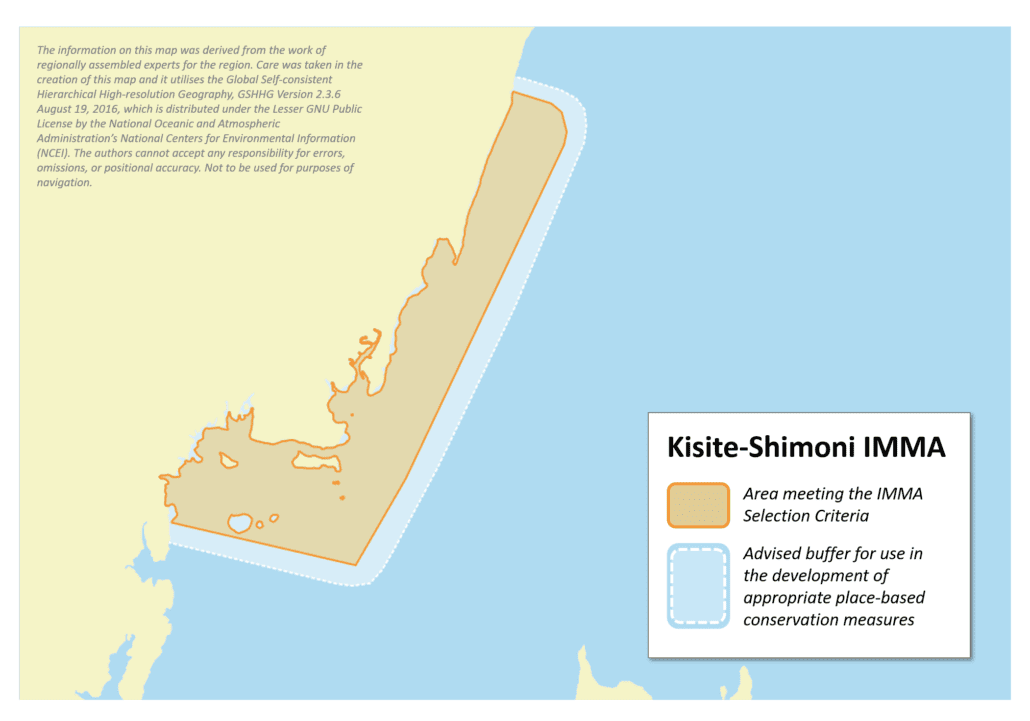
Size in Square Kilometres
726
Qualifying Species and Criteria
Indo-Pacific bottlenose dolphin – Tursiops aduncus
Criterion B (1)
Indian Ocean humpback dolphin – Sousa plumbea
Criterion A; B (1)
Humpback whale – Megaptera novaeangliae
Criterion C (1)
Criterion D (2) – Marine Mammal Diversity
Other Marine Mammal Species Documented
Dugong dugon, Stenella longirostris
Summary
The Kisite-Shimoni IMMA is located in the coastal waters of southern Kenya adjacent to the Tanzanian border and includes the Kisite-Mpunguti National Marine Park and Reserve. A small resident population of Indo-Pacific bottlenose dolphins (Tursiops aduncus) has been the regular target of dolphin watching tourism in the area. The population shows a high degree of site fidelity and relies on the habitat within the area for both feeding and breeding. Endangered Indian Ocean humpback dolphins (Sousa plumbea) and spinner dolphins (Stenella longirostris) are also observed within the Kisite-Shimoni area year-round. Between July and October each year, the habitat is also used for both calving and nursing by humpback whales (Megaptera novaeangliae) from the Southern Hemisphere designated as ‘Breeding Stock C’ by the International Whaling Commission.
Description of Qualifying Criteria
Criterion A – Species or Population Vulnerability
The Indian Ocean humpback dolphin (Sousa plumbea) is currently designated under the IUCN Red List as Endangered (Braulik et al., 2017a). There is a population of Indian Ocean humpback dolphins that occur within the waters of the area that is estimated to number approximately 100 individuals (Morley et al. 2011, Meyler et al. 2011).
Criterion B – Distribution and Abundance
Sub-criterion B1 – Small and Resident Populations
The near-shore waters of the Shimoni coast are home to resident Indo-Pacific bottlenose (Tursiops aduncus) and humpback dolphins (Sousa plumbea). Based on a robust dataset of 367 photo-identification sessions (137 individuals identified) collected over 551 dedicated vessel-based surveys (~13850km of survey effort) between January 2006 and December 2009, the population size of Indo-Pacific bottlenose dolphins was estimated as ranging from 19 individuals (95% CI: 11–33) to a maximum of 104 dolphins (95% CI: 78–139) with a mean of 62 dolphins estimated (SE: 6.66) (Pérez-Jorge et al. 2016). The individual recapture rate ranged from 1 to 75 with an average of 19 (SD: 19.76) recaptures along the study period 2006-2009. There was a very high degree of residence of individuals within the area and a low proportion of transient individuals in the population (Pérez-Jorge et al. 2016). Abundance estimates were roughly stable from 2006 to 2009 (Pérez-Jorge et al. 2016). Similarly, it is estimated that there are approximately 104 Indian Ocean humpback dolphins that utilize the area (Meyler et al. 2011).
Sub-criterion B2 – Aggregations
Criterion C: Key Life Cycle Activities
Sub-criterion C1 – Reproductive Areas
Long-term photo-identification programs provides strong information on the importance of Kisite as a reproductive area for the Indo-Pacific bottlenose dolphin. From 2006 to 2012, a total of 182 individuals were identified around the Kisite-Mpunguti Marine Protected Area and surrounding waters, with at least 27 individuals identified as females, accounting for approximately 15% of the population (Pérez-Jorge, S, unpublished data; Kenya Marine Mammal Network Newsletter 3). This area is an important reproductive habitat for humpback whales, as it is used regularly every year for calving and nursing. During the period 2007-2012, 61 individuals were photo-identified passing through the study area of Kisite-Mpunguti MPA (Pérez-Jorge unpublished data, Kenya Marine Mammal Network Newsletter 3).
Sub-criterion C2: Feeding Areas
Sub-criterion C3: Migration Routes
C3a – Whale Seasonal Migratory Route
C3b – Migration / Movement Area
Criterion D – Special Attributes
Sub-criterion D1 – Distinctiveness
Sub-criterion D2 – Diversity
Supporting Information
Cockcroft, V.G., Findlay, K.P. Guissamulo, A.T., Lindsay West, Mohamed, M. 2018. Dugongs (Dugong dugon) of the Western Indian Ocean Region: – Identity, Distribution, Status, Threats and Management. Western Indian Ocean Science Association Final Technical Report.143pp.
Heithaus, M., Kiszka, J., Cadinouche, A., Dulau-Drouot, V., Boucaud, V., Pérez-Jorge, S. and Webster, I. 2017. Spatial variation in shark-inflicted injuries to Indo-Pacific bottlenose dolphins (Tursiops aduncus) of the western Indian Ocean. Marine Mammal Science, 33: 335-341
Kenya Marine Mammal Network. 2012-2013. Newsletters 1-4. Available online: https://kenyammnetwork.wixsite.com/kmmnetwork/newsletter
Pérez-Jorge, S., Louzao, M., Oro, D., Pereira, T., Corne, C., Wijtten, Z., Gomes, I., Wambua, J. and Christiansen, F. 2017. Estimating the cumulative effects of the nature-based tourism in a coastal dolphin population from southern Kenya. Deep Sea Research II: Topical Studies in Oceanography. 140: 278-289.
Pérez-Jorge, S., Gomes, I., Hayes, K., Corti, G., M. Louzao, M and Oro, D. 2016. Effects of nature-based tourism and environmental drivers on the demography of a small dolphin population. Biological Conservation, 197: 200-208.
Pérez-Jorge, S., Pereira, T., Corne, C., Wijtten, Z., Omar, M., Katello, J., Kinyua, M. Oro, D. and Louzao, M. 2015. Can static habitat protection encompass critical areas for highly mobile marine top predators? Insights from coastal East Africa. PLoS ONE 10(7).
Pérez-Jorge, S., Pereira, T., Corne, C., Wijtten, Z., Omar, M., Katello, J., Kinyua, M. Oro, D. and Louzao, M .2015. Integrative assessment of human dimension on the conservation of the Indo-Pacific bottlenose dolphin in Kenya. Devotes-Euro Marine Summer School, Spain.
Articles from periodicals or journals (issues, volumes):
Findlay, K.P., Cockcroft, V.G., and AT Guissamulo. 2011. Dugong abundance and distribution in the Bazaruto Archipelago, Mozambique. African Journal of Marine Science 2011, 33(3): 441-452
Papers delivered during meetings or conferences:
Morley, K., Pérez-Jorge, S., Omar, M., Lemarkat, R., and Corti, G. 2011. Abundance and spatial distribution of Indo-Pacific humpback dolphins (Sousa chinensis) and possible threats on the south coast of Kenya. Proceeding in the 7th Western Indian Ocean Marine Science Association, Kenya.
Gilbert Mwang’ombe, M., Pérez-Jorge, S., Katana Charo, K., Kahindi Yaa, J., Njuguna, N., Trott, S.J., and Spilsbury, J.H. 2015. Cetacean species distribution and encounter rates in the Malindi – Watamu National Marine Reserve 2011 – 2014. Proceeding in the 9th Western Indian Ocean Marine Science Association, Kenya.
Pérez-Jorge, S., Gomes, I., Morley, K., Omar, M., Lemarkat, R., Oro, D., Karczmarksi, L and Corti, G. .2011. Cetaceans around Kisite-Mpunguti Marine Protected Area (Kenya): Spatio-temporal distribution and encounter rate. Proceeding in the 7th Western Indian Ocean Marine Science Association, Kenya.
Pérez-Jorge, S., Gomes, I., Crouthers, R., Lemarkat, R. and Corti, G. .2010. Indo-Pacific bottlenose dolphin (Tursiops aduncus) population study of Kisite-Mpunguti Marine Protected Area, East Africa. Proceeding in the European Cetacean Society Annual Meeting in Stralsund, Germany.
Downloads
Download the full account of the Kisite-Shimoni IMMA using the Brochure button below:
To make a request to download the GIS Layer (geopackage and/or geojson) for the Kisite-Shimoni IMMA please complete the following Contact Form: