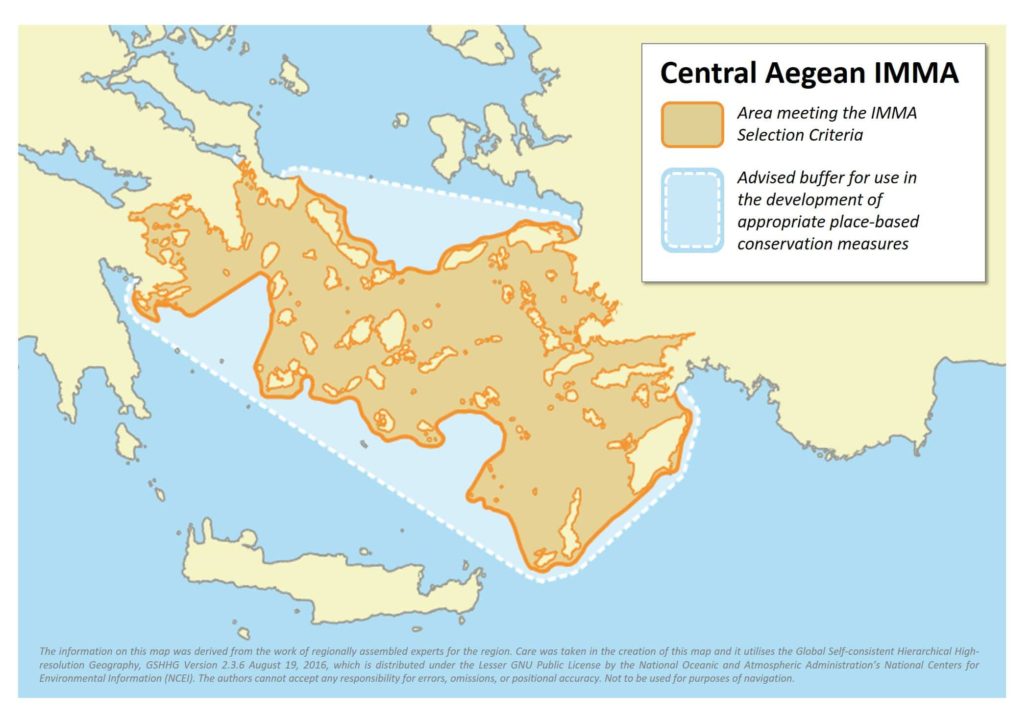
Size in Square Kilometres
58265
Qualifying Species and Criteria
Mediterranean monk seal – Monachus monachus
Criterion A; C (1)
Criterion D (2) – Marine Mammal Diversity
Other Marine Mammal Species Documented
Delphinus delphis, Stenella coeruleoalba, Tursiops truncatus
Summary
This wide area of the Central Aegean encompasses a suite of important habitats for Endangered Mediterranean monk seals (Monachus monachus). The area extends seaward to the 200m isobath, with certain parts of the area having depths greater than 200m. These occur around nearby islands; it is known from telemetry studies that monk seals easily cross such deeper areas even though they tend to spend their time in shallower water. Monk seals here concentrate in specific breeding nuclei, but the area also includes numerous locations where more isolated mother and pup pairs are observed regularly during the pupping season. Such activities are fairly dispersed in occurrence over the broad area and are consistent with the seals’ known socioecology.
Description of Qualifying Criteria
Criterion A – Species or Population Vulnerability
The IUCN Red List of Threatened Species classifies the Mediterranean monk seal as Endangered [EN C2a(i)] and infers that their numbers are declining from significant anthropogenic threats. Minimum number estimated for the species in the area is 151 animals, including pups, which represents 23.2% of the global population.
Criterion B – Distribution and Abundance
Sub-criterion B1 – Small and Resident Populations
Sub-criterion B2 – Aggregations
Criterion C: Key Life Cycle Activities
Sub-criterion C1 – Reproductive Areas
The main criterion upon which the IMMA was identified was based on the knowledge that the area contains pupping nuclei of monk seals, and caves discovered to be used for resting and pupping.
Sub-criterion C2: Feeding Areas
Sub-criterion C3: Migration Routes
C3a – Whale Seasonal Migratory Route
C3b – Migration / Movement Area
Criterion D – Special Attributes
Sub-criterion D1 – Distinctiveness
Sub-criterion D2 – Diversity
Supporting Information
Cebrian, D. 1998. La foca monje (Monachus monachus Hermann 1779) en el Mediterráneo oriental (Grecia y Croacia). Ed. Universidad Complutense de Madrid. Madrid. 367 pp plus 2 appendices.
Cebrian, D. 2005. Information Report on the Status of the Monk Seal in the Mediterranean. Ed. UNEP/MAP-RAC/SPA.
Convention on Biological Diversity. 2014. Report of The Mediterranean Regional Workshop To Facilitate The Description Of Ecologically Or Biologically Significant Marine Areas. Mediterranean Regional Workshop To Facilitate The Description Of Ecologically Or Biologically Significant Marine Areas. Málaga, 7 to 11 April 2014
Karamanlidis, A.A., Dendrinos, P., Fernández de Larrinoa, P., Gücü, A.C., Johnson, W.M., Kiraç, C.O., Pires, R. 2015. The Mediterranean monk seal Monachus monachus: status, biology, threats, and conservation priorities. Mammal Review 46(2):92-105. DOI: 10.1111/mam.12053
Legakis, A., Maragou, P. (Editors). 2009. The Red Data Book of endangered animals of Greece. Athens, Greece: Ministry of the environment and Hellenic Zoological Society.
Notarbartolo di Sciara, G., Bearzi, G. 2010. National Strategy and Action Plan for the conservation of cetaceans in Greece, 2010-2015. Initiative for the Conservation of Cetaceans in Greece, Athens. 55 pp.
Notarbartolo di Sciara, G., Kotomatas, S. 2016. Are Mediterranean monk seals, Monachus monachus, being left to save themselves from extinction? In: G. Notarbartolo di Sciara, M. Podestà, B.E. Curry (Editors), Mediterranean marine mammal ecology and conservation. Advances in Marine Biology 75:361-388. http://dx.doi.org/10.1016/bs.amb.2016.08.004
Notarbartolo di Sciara, G., Adamantopoulou, S., Androukaki, E., Dendrinos, P., Karamanlidis, A.A., Paravas, V. Kotomatas, S. 2009. National strategy and action plan for the conservation of the Mediterranean monk seal in Greece, 2009 ‐ 2015. MOm, Athens: 1‐ 19.
Dendrinos, P., Karamanlidis, A.A., Androukaki, E. and McConnell, B.J. 2007. Diving development and behaviour of a rehabilitated Mediterranean monk seal (Monachus monachus). Marine Mammal Science 23: 387-397.
Frantzis, A. 2009. Cetaceans in Greece: present status of knowledge. Initiative for the Conservation of Cetaceans in Greece, Athens, Greece. 94 p.
Downloads
Download the full account of the Central Aegean IMMA using the Brochure button below:
To make a request to download the GIS Layer (geopackage and/or geojson) for the Central Aegean IMMA please complete the following Contact Form: