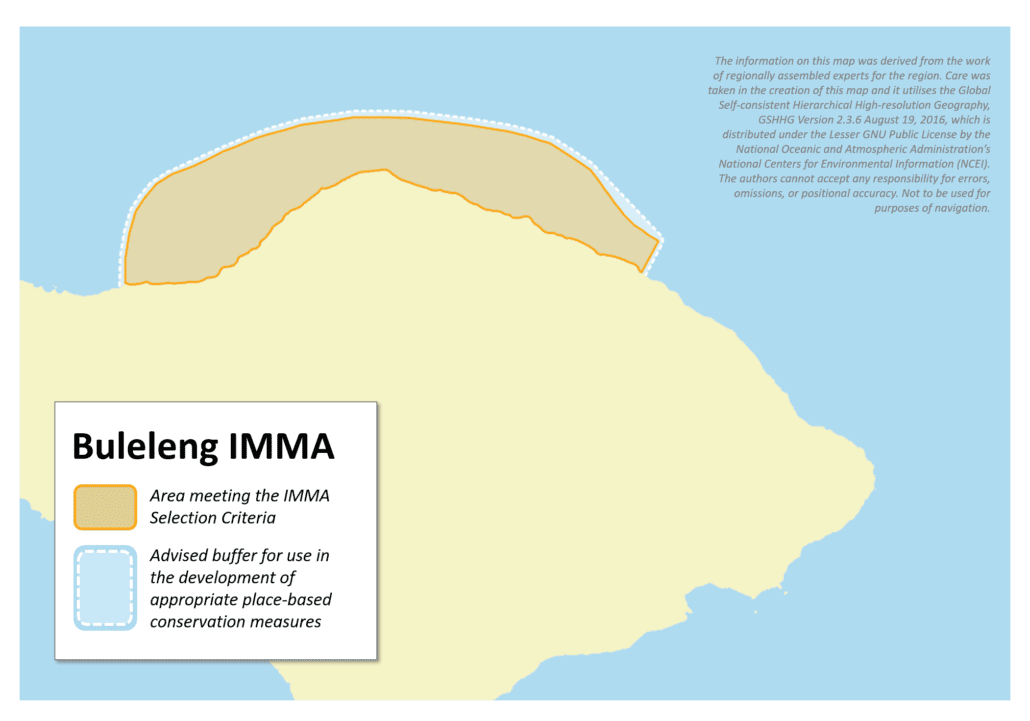
Size in Square Kilometres
583
Qualifying Species and Criteria
Fraser’s dolphin – Lagenodelphis hosei
Criterion B (2); C (1)
Spinner dolphin – Stenella longirostris
Criterion B (2); C (1)
Criterion D (2) – Marine Mammal Diversity
Other Marine Mammal Species Documented
Globicephala macrorhynchus, Grampus griseus, Stenella attenuata, Tursiops truncatus
Summary
The Buleleng IMMA is located at the northern shores of Bali in Indonesia. The depth contour drops off to 200 m between 2-5 km from the shore and to 500 m between 5-8 km from the shore. These sloping submarine areas create an important environment for spinner dolphins (Stenella longirostris) and Fraser’s dolphins (Lagenodelphis hosei). In the Lovina (western) section dolphins are likely attracted by bathymetry features, while in the Tejakula (eastern) section dolphins are likely facilitated by both bathymetry and steep slopes. Both of these locally occurring populations are consistently observed feeding, and calves are regularly observed. The IMMA is also regularly inhabited by at least four more species, and a Lovina-based dolphin watching tourism industry may threaten these dolphin species. The Buleleng IMMA encompasses the Lovina MPA and the Tejakula MPA.
Description of Qualifying Criteria
Criterion A – Species or Population Vulnerability
Criterion B – Distribution and Abundance
Sub-criterion B1 – Small and Resident Populations
Sub-criterion B2 – Aggregations
Spinner (Stenella longirostris) and Fraser’s (Lagenodelphis hosei) dolphins have been regularly observed aggregating at the Lovina and Tejakula sections of the Buleleng IMMA (Mustika, 2011; Purba, 2018, pers.comm.). No abundance estimations have been produced but the observations were made systematically using line transects (Mustika, 2011; Purba, 2018, pers.comm.) or point samplings. The regular aggregations of these species have led to the development of dolphin watching industries in both sections (the late 1980s in Lovina and early 2000s in Tejakula).
Criterion C: Key Life Cycle Activities
Sub-criterion C1 – Reproductive Areas
Calves of both species have been regularly observed in both sections of the Buleleng IMMA, with occasional neonate dolphins also being observed. The calves in the Lovina section were regularly sighted since late 2007 until mid-2010 (Mustika, 2011), although no further surveys have been made ever since. The calves in the Tejakula section have also been sighted during Mustika’s two field visits in 2011 and 2012 (Purba 2018, pers.comm) and during Purba’s study in the area (Purba 2018, pers.comm).
Sub-criterion C2: Feeding Areas
Sub-criterion C3: Migration Routes
C3a – Whale Seasonal Migratory Route
C3b – Migration / Movement Area
Criterion D – Special Attributes
Sub-criterion D1 – Distinctiveness
Sub-criterion D2 – Diversity
Supporting Information
Mustika, P.L.K., 2011. Towards sustainable dolphin watching tourism in Lovina, Bali, Indonesia (Doctoral dissertation, James Cook University).
Mustika, P.L.K., Birtles, A., Everingham, Y. and Marsh, H., 2015. Evaluating the potential disturbance from dolphin watching in Lovina, north Bali, Indonesia. Marine Mammal Science, 31:808-817.
Purba, A.O. 2018. Personal communication. Udayana University, Denpasar, Bali.
Downloads
Download the full account of the Buleleng IMMA using the Brochure button below:
To make a request to download the GIS Layer (geopackage and/or geojson) for the Buleleng IMMA please complete the following Contact Form: