October 2026.
This month, the IUCN SSC WCPA Marine Mammal Protected Areas Task Force, dedicated to identifying the habitats of whales and other marine mammals, announces that it has been invited by IUCN to form a Specialist Group. The new group would sit within the IUCN and its two commissions, the Species Survival Commission (SSC) and the World Commission on Protected Areas (WCPA).
This changes the group from a temporary, more informal Task Force to a permanent Specialist Group. The new full name is the IUCN SSC WCPA Important Marine Mammal Areas Specialist Group. Or, for short: the IMMA Specialist Group.
“We are honoured to be asked to become a permanent body within the International Union for Conservation of Nature, the IUCN,” says Specialist Group co-chair Giuseppe Notarbartolo di Sciara.
Co-chair Erich Hoyt adds: “We like to describe our work as giving whales and other marine mammals a seat at the negotiating table when it comes to marine spatial planning, EIA assessments and creating new or expanded marine protected areas in national waters and on the high seas. That will continue to be our guiding mission.”
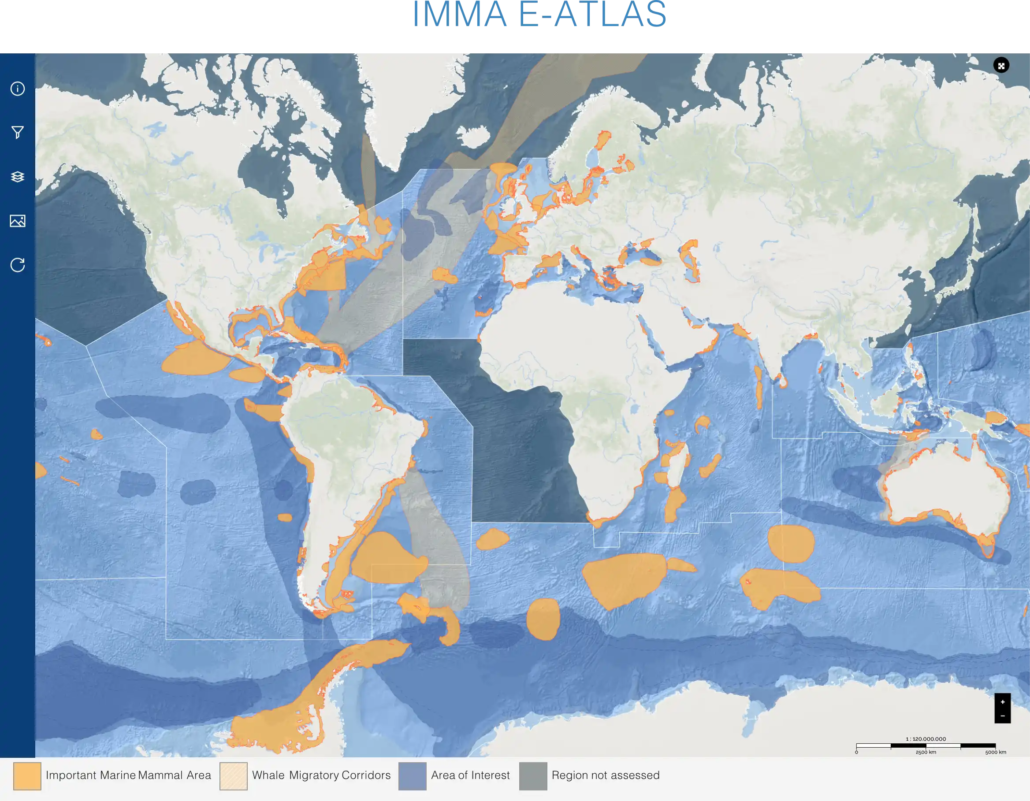
For the past 13 years since its founding, the Task Force/ IMMA Specialist Group has devised, developed and launched the new Important Marine Mammal Area (IMMA) tool for biodiversity conservation. To date, working with more than 350 regional experts and a dedicated review panel, the group has examined 79.1% of the global ocean and put 323 IMMAs and 191 Areas of Interest (AoI) on the map, making them easily accessible for policymakers, governments and a wide variety of users. The IMMA shapefiles and layer have been downloaded by more than 1500 users to date.
The expanding role and permanence of the IMMA Specialist Group is timely with the CBD Conference of the Parties (CoP17) meeting in Yerevan, Armenia, from 19 to 30 October. In partnership with GOBI, the Global Ocean Biodiversity Initiative, the IMMA Specialist Group has played a central role with CBD’s ecologically or biologically significant areas, the EBSAs. IMMAs are marine mammal layers designed to support the identification of EBSAs; in addition, many IMMAs are based partly on EBSAs.
In late November-early December this year, the IMMA work forges on, with the IMMA Specialist Group travelling to Saly, Senegal, to focus on the Southeastern Atlantic (western African coast) with 30 experts from the region. This effort, part of Global Ocean Programme Component 1 funded by the EU and implemented by IUCN, will complete the IMMA work in the southern hemisphere and in the Atlantic. The remaining three regions awaiting IMMA examination and subject to further funding are the northeastern and northwestern Pacific and the Arctic. That will complete the more than a decade long tour through the global ocean.
In the years to come, the IMMA team plans to revisit and expand efforts to identify more IMMAs in each of the 15 ocean regions which include substantial portions of the high seas. Currently, 48% of all the IMMAs are in the high seas, while 52% are in national EEZ waters. IMMAs occupy 11.2% of the high seas areas beyond national jurisdiction (ABNJ) surface. Spatial tools like IMMAs have gained substantial currency with the push for high seas MPAs under the High Seas Treaty, which came into effect earlier this year.
Besides IMMA identification, the IMMA group has also been involved in monitoring and implementation projects in a number of IMMAs in South America, Southeast Asia, East Africa and the Caribbean. Recently, a survey of the more than 1500 users of the IMMA layer has been conducted revealing many unforeseen positive outcomes. The results will be published in early 2027.
Primary support for the IMMA project has come from the GOBI-IKI project sponsored by the German government covering seven of the nearly year-long regional investigations. Four other regions were sponsored by the French Biodiversity Agency, Water Revolution Foundation and MAVA Foundation, with help from University of St Andrews, Animal Welfare Institute, OceanCare, and others, and administrative support from the Tethys Research Institute and Whale and Dolphin Conservation.Primary support for the IMMA project has come from the GOBI-IKI project sponsored by the German government covering seven of the nearly year-long regional investigations. Four other regions were sponsored by the French Biodiversity Agency, Water Revolution Foundation and MAVA Foundation, with help from University of St Andrews, Animal Welfare Institute, OceanCare, and others, and administrative support from the Tethys Research Institute and Whale and Dolphin Conservation.