Size in Square Kilometres
50034
Qualifying Species and Criteria
Humpback Whale – Megaptera novaeangliae
Criterion A; B (2); C (1); D (1)
Spinner dolphin – Stenella longirostris
Criterion B (2); C (1); D (1)
Criterion D (2) – Marine Mammal Diversity
Balaenoptera acutorostrata, Balaenoptera bonaerensis, Balaenoptera borealis, Balaenoptera edeni, Balaenoptera musculus brevicauda, Feresa attenuata, Globicephala macrorhynchus, Grampus griseus, Kogia sima, Megaptera novaeangliae, Orcinus orca, Peponocephala electra, Physeter macrocephalus, Pseudorca crassidens, Stenella attenuata, Stenella longirostris, Steno bredanensis, Tursiops truncatus, Ziphius cavirostris
Other Marine Mammal Species Documented
Summary
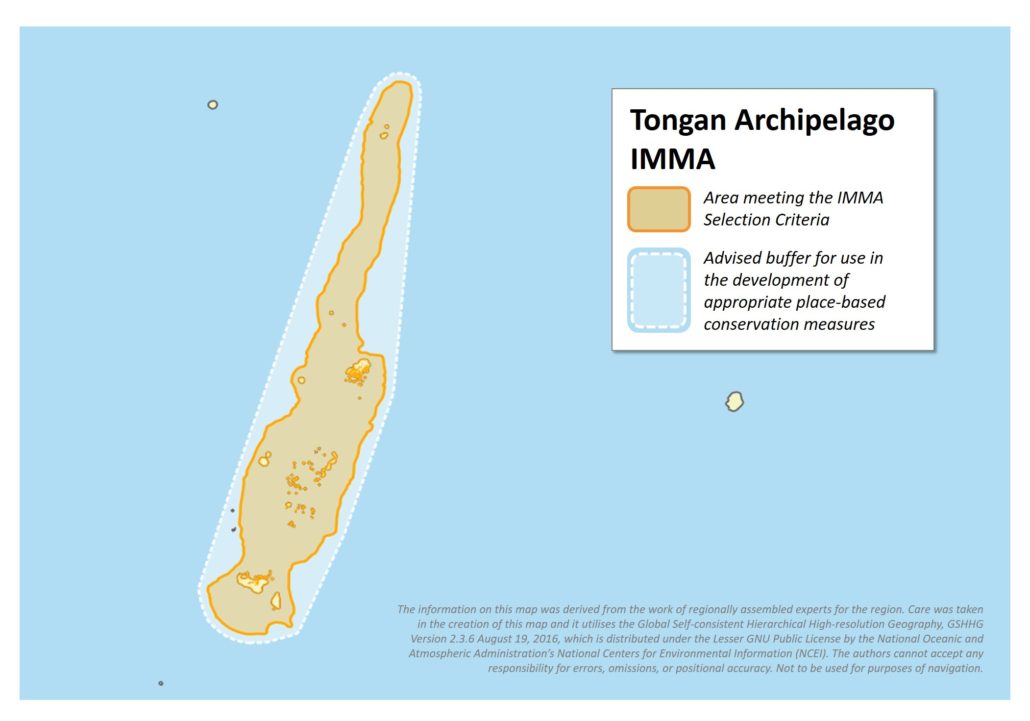
The Tongan Archipelago spans approximately 800 km from Niuafo’ou in the north to Eua in the south. Research has focused on the main island groups with concentrated efforts on humpback whales (Megaptera novaeangliae) in the coastal waters that form their winter breeding grounds from August – November. There is natal site fidelity of humpback whales to the Tongan breeding grounds with distinctive mtDNA haplotypes for this area. Humpback whales and seven additional species of whale have been seen or acoustically detected within the Tongan Archipelago IMMA. Spinner dolphins (Stenella longirostris) are sighted year-round in Vava’u but no other delphinids are known to be resident despite sightings of nine additional species.
Description of Qualifying Criteria
Criterion A – Species or Population Vulnerability
The Oceania humpback whale (Megaptera novaengliae) population, of which Tonga forms a sub-population, is assessed as Endangered (EN A1) on the IUCN Red List. The Oceania abundance estimate was 4,329 (CV = 0.12, 3,345-5,313) whales in 2003 (Constantine et al. 2012). Models for the recovery of the Oceania sub-populations suggest this stock likely remain below 30% of pre-exploitation abundance and is recovering at a slower rate than other populations (Jackson et al. 2007). The abundance estimate for the Tongan humpback whales is now over a decade old and given the absence of direct threats, the population is likely to have increased.
Criterion B – Distribution and Abundance
Sub-criterion B1 – Small and Resident Populations
Sub-criterion B2 – Aggregations
The nearshore waters of all island groups in the Tongan Archipelago are critical habitat where humpback whales aggregate for breeding during the winter months. In Vava’u this habitat is important for all sex- and age-class groups of whales (Lindsay et al. 2016). Similar aggregations of whales occur in the Ha’apai group (Kessler & Harcourt 2012) and in Eua (Constantine et al. 2014).
There is an aggregation of spinner dolphins (Stenella longirostris) that has been sighted over multiple years in the white cliffs area of Vava’u. There is little information to infer the residency pattern of individuals within and between years, but the consistency with which spinner dolphins are observed in the region suggests its importance to the species. Spinner dolphins have been reported at Tongatapu (D. Donnelly unpub. data) and it is possible that further populations of this species exist in other areas throughout the Tongan Archipelago. Sightings records are from reliable sources, but effort is lacking.
Criterion C: Key Life Cycle Activities
Sub-criterion C1 – Reproductive Areas
The Tongan islands form critical annual winter calving and mating habitat for humpback whales (Constantine et al. 2012, Lindsay et al. 2016). Stenella longirostris Calves have been observed in Vava’u which is expected for a resident population of dolphin (South Pacific Whale Research Consortium unpub. data). There are no data on the calving rates or any other demographic information on the spinner dolphins in Vava’u that allow another classification at this time.
Sub-criterion C2: Feeding Areas
Sub-criterion C3: Migration Routes
C3a – Whale Seasonal Migratory Route
C3b – Migration / Movement Area
Criterion D – Special Attributes
Sub-criterion D1 – Distinctiveness
There are movements of humpback whales between island groups by some individuals and low levels of interchange with other breeding grounds throughout Oceania (Garrigue et al. 2002, 2011). Overall, there is strong natal site fidelity with mitochondrial DNA haplotypes distinctive to Tongan whales (Olavarría et al. 2007).
Available genetic samples of spinner dolphins from Vava’u show significant differentiation from other South Pacific Island populations but the sample size is small (Baker 2015). Further samples from Vava’u and other regions in the Tongan Archipelago would be useful to confirm distinctiveness.
Sub-criterion D2 – Diversity
In addition to humpback whales and spinner dolphins, there are a number of secondary species reported in the Tongan Archipelago IMMA. There are seven other species of whale reported to date; pygmy blue, sperm, dwarf and Antarctic minke, kogia, sei and Bryde’s-like whales and one report of a stranded Cuvier’s beaked whale. In addition, there are nine other species of delphinid; short-finned pilot, false killer, pygmy killer, melon-headed and killer whales, pan-tropical spotted, rough-toothed, common bottlenose and Risso’s, dolphins (Miller 2009, SPREP 2014, South Pacific Whale Research Consortium and D. Donnelly unpub. data).
Supporting Information
Baker, C.S. 2015. A pattern of dolphin (aPOD) – the seascape genetics of island populations in protected and unprotected habitats of Oceania. Final Report to Pew Foundation.
Balcazar, N.E., Tripovich, J.S., Klinck, H., Nieukirk, S.L., Mellinger, D.K., Dziak, R.P., Rogers, T.L. 2015. Calls reveal population structure of blue whales across the southeast Indian Ocean and the southwest Pacific Ocean. Journal of Mammalogy 96: 1184-1193. https://doi.org/10.1093/jmammal/gyv126
Constantine, R., Jackson, J.A., Steel, D., Baker, C.S., Brooks, L., Burns, D., Clapham, P., Hauser, N., Madon, B., Mattila, D., Oremus, M., Poole, M., Robbins, J., Thompson, K., Garrigue, C. 2012. Abundance of humpback whales in Oceania using photo-identification and microsatellite genotyping. Marine Ecology Progress Series 453: 249−261. doi: 1-.3354/meps09613
Garrigue, C., Aguayo, A., Amante-Helweg, V.L.U., Baker, C.S. 2002. Movements of humpback whales in Oceania, South Pacific. Fisheries Science 4: 255−260.
Garrigue, C., Constantine, R., Poole, M., Hauser, N. 2011. Movement of individual humpback whales between wintering grounds of Oceania (South Pacific), 1999 to 2004. Journal of Cetacean Research and Management 3: 275−281.
Garrigue, C., Clapham, P.J., Geyer, Y., Kennedy, A.S., Zerbini, A.N. 2015. Satellite tracking reveals novel migratory patterns and the importance of seamounts for endangered South Pacific humpback whales. Royal Society Open Science 2: 150489
Jackson, J.A., Zerbini, A., Clapham, P., Constantine, R., Garrigue, C., Hauser, N., Poole, M.M., Baker, C.S. 2013. Population modelling of humpback whales in East Australia (BSE1) and Oceania (BSE2, BSE3, BSF2). Report SC/65A/SH07 to the Scientific Committee of the International Whaling Commission.
Kessler, M., Harcourt, R. 2012. Management implications for the changing interactions between people and whales in Ha’apai, Tonga. Marine Policy 36: 440-445. http://dx.doi.org/10.1016/j.marpol.2011.08.004
Lindsay, R.E., Constantine, R., Robbins, J., Mattila, D.K., Tagarino, A., Dennis, T.E. 2016. Characterising essential breeding habitat for whales informs the development of large-scale Marine Protected Areas in the South Pacific. Marine Ecology Progress Series 548: 263-275. doi: 10.3354/meps11663
Miller, C. 2009. Current state of knowledge of cetacean threats, diversity and habitats in the Pacific Islands region, 2009 Revision. Report to the Convention of Migratory Species. Whale and Dolphin Conservation Society, July 2009.
Olavarría, C., Baker, C.S., Garrigue, C., Poole, M., Hauser, N., Caballero, S., Flórez-González, L., Brasseur, M., Bannister, J., Capella, J., Clapham, P., Dodemont, R., Donoghue, M., Jenner, C., Jenner, M.N., Moro, D., Oremus, M., Paton, D., Rosenbaum, H., Russell, K. 2007. Population structure of humpback whales throughout the South Pacific and the origins of the eastern Polynesian breeding grounds. Marine Ecology Progress Series 330:257-268. doi: 10.3354/meps330257
SPREP. 2014. Rapid biodiversity assessment (BIORAP) Vava’u Group – Kingdom of Tonga. Final Report, South Pacific Regional Environment Programme, February 2014.
Downloads
Download the full account of the Tongan Archipelago using the Brochure button below:
To make a request to download the GIS Layer (geopackage and/or geojson) for the Tongan Archipelago please complete the following Contact Form: