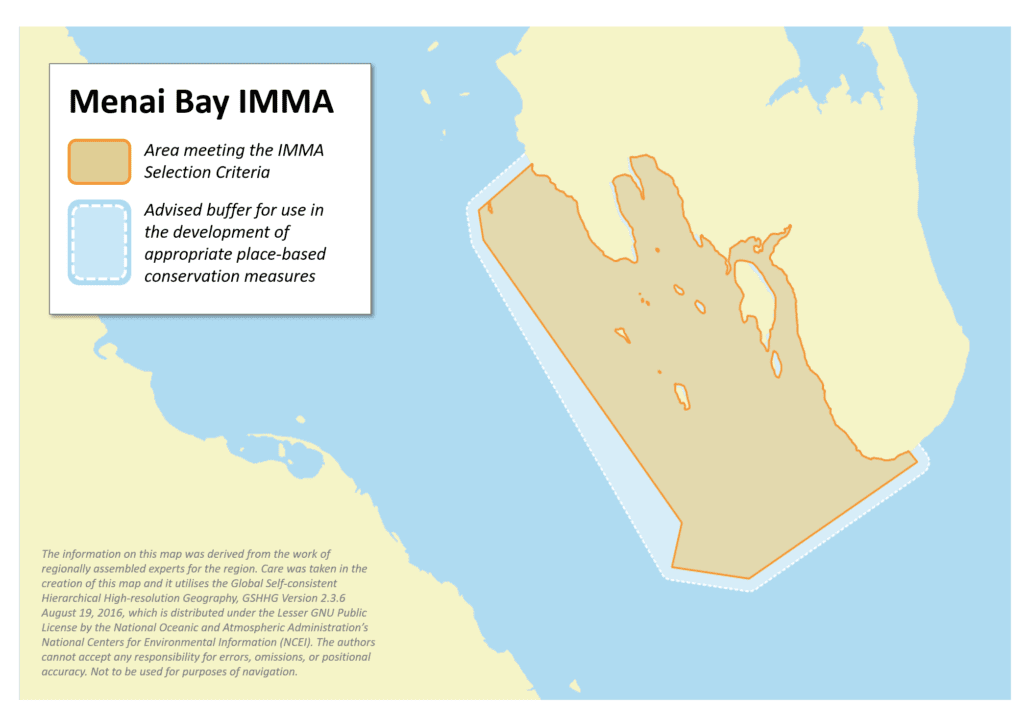
Size in Square Kilometres
648
Qualifying Species and Criteria
Indo-Pacific Bottlenose Dolphin – Tursiops aduncus
Criterion C (2)
Indian Ocean humpback dolphin – Sousa plumbea
Criterion A; B (1); C (2)
Criterion D (2) – Marine Mammal Diversity
Other Marine Mammal Species Documented
Megaptera novaeangliae, Stenella longirostris
Summary
The Menai Bay Conservation Area (MBCA) off the southwest coast of Zanzibar, East Africa, has been a designated conservation area since August 1997. Two marine mammal species, the Endangered Indian Ocean humpback dolphin (Sousa plumbea) and the Indo-Pacific bottlenose dolphin (Tursiops aduncus), are resident in the area, and both species show high levels of site fidelity. The MBCA provides sheltered, shallow habitat, which is important to both species for activities such as feeding, resting and nursing their young. It is particularly important for the humpback dolphin, a species that is restricted to shallow coastal waters and relies on near-shore habitat for foraging. A recently published abundance estimate of the Indian Ocean humpback dolphin in the MBCA indicates that as few as 19 individuals remain, indicating a 63% reduction in total abundance since 2002. The population is affected by unsustainable bycatch in artisanal gillnet fisheries and pressure from unregulated dolphin watching activities.
Description of Qualifying Criteria
Criterion A – Species or Population Vulnerability
The Indian Ocean humpback dolphin (Sousa plumbea) is currently designated under the IUCN Red List as Endangered due to its low reproductive capacity and overlap with human activities (Braulik et al., 2017a). A population specific decline in the MBCA has been observed (Sharpe and Berggren, 2019) which has likely been driven by fisheries bycatch and habitat degradation. Population viability analysis predicts a very high risk of local extinction within three generations unless anthropogenic causes of mortality are prevented. The population is particularly sensitive to the removal of mature females, with the removal of a single individual per year representing an unsustainable level of bycatch (Sharpe and Berggren, In Press).
Criterion B – Distribution and Abundance
Sub-criterion B1 – Small and Resident Populations
Mark–recapture analyses based on data from 2002 estimated that there were 136 (log-normal 95% CI 124–172) Indo-Pacific bottlenose dolphins and 63 (log-normal 95% CI 57–95) Indian Ocean humpback dolphins (Stensland et al. 2006). A 2015 abundance estimate of Indo-Pacific bottlenose dolphins in Menai Bay was 114 (95% CI 89-144) individuals and for Indian Ocean humpback dolphins 19 (95% CI 14-25) individuals (Sharpe 2018; Sharpe and Berggren, 2019). Further investigation into the spatial patterns in sightings of both species identified a high degree of residency and a small core area that is regularly used within the MBCA (Stensland et al., 2006). A genetic study revealed the isolation of the MBCA Indo-Pacific bottlenose dolphin population to a putative population off the north coast of Zanzibar, suggesting both populations should be considered distinct communities (Särnblad et al., 2011).
Sub-criterion B2 – Aggregations
Criterion C: Key Life Cycle Activities
Sub-criterion C1 – Reproductive Areas
Sub-criterion C2: Feeding Areas
Menai Bay provides rich foraging grounds for humpback dolphins, which are reliant on nearshore reef habitats within the area for feeding activities. Indian Ocean humpback dolphins rely on patchy habitat for foraging (Karczmarski et al., 2000; Keith et al., 2013). Delineating this limited habitat within the populations range and protecting it from fisheries interaction and other anthropogenic impact is considered to be vital in avoiding local extinction of the animals using the MBCA.
Sub-criterion C3: Migration Routes
C3a – Whale Seasonal Migratory Route
C3b – Migration / Movement Area
Criterion D – Special Attributes
Sub-criterion D1 – Distinctiveness
Sub-criterion D2 – Diversity
Supporting Information
Amir, O.A. 2010. ‘Biology, ecology and anthropogenic threats of Indo-Pacific bottlenose dolphins in east Africa’. PhD Thesis. Stockholm University, Sweden. ISBN 978-91-7447-002-4.
Berggren, P., Amir, O.A., Guissamulo, A., Jiddawi, N.S., Ngazy, Z., Stensland, E., Särnblad, A. and G., Cockroft, V. 2007. ‘Sustainable Dolphin Tourism in East Africa. MASMA Technical Report’. WIOMSA Book Series No 7, ix+72pp.
Braulik, G.T., Findlay, K., Cerchio, S. and Baldwin, R. 2015. ‘Chapter Five-Assessment of the Conservation Status of the Indian Ocean Humpback Dolphin (Sousa plumbea) Using the IUCN Red List Criteria’. Advances in Marine Biology, 72:119-141.
Braulik, G., Wittich, A., Macaulay, J., Kasuga, M., Gordon, J., Davenport, T.R. and Gillespie, D. 2017. ‘Acoustic monitoring to document the spatial distribution and hotspots of blast fishing in Tanzania’. Marine Pollution Bulletin, 125:360-366.
Braulik, G.T., Findlay, K., Cerchio, S., Baldwin, R. and Perrin, W. 2017b. ‘Sousa plumbea. The IUCN Red List of Threatened Species 2017’. e.T82031633A82031644.
http://dx.doi.org/10.2305/IUCN.UK.2017-3.RLTS.T82031633A82031644.en
Christiansen, F., Lusseau, D., Stensland, E. and Berggren, P. 2010. ‘Effects of tourist boats on the behaviour of Indo-Pacific bottlenose dolphins off the south coast of Zanzibar’. Endangered Species Research, 11:91-99.
James, B.S., Bester, M.N., Penry, G.S., Gennari, E. and Elwen, S.H. 2015. ‘Abundance and degree of residency of humpback dolphins Sousa plumbea in Mossel Bay, South Africa’. African Journal of Marine Science, 37:383-394.
Karczmarski, L., Cockcroft, V.G. and McLachlan, A. 2000. ‘Habitat use and preferences of Indo Pacific humpback dolphins Sousa chinensis in Algoa Bay, South Africa’. Marine Mammal Science, 16:65-79.
Karczmarski, L., Winter, P.E.D., Cockcroft, V.G. and McLachlan, A. 1999. ‘Population analyses of Indo Pacific humpback dolphins Sousa chinensis in Algoa Bay, Eastern Cape, South Africa’. Marine Mammal Science 15:1115-1123.
Keith, M., Atkins, S., Johnson, A.E. and Karczmarski, L. 2013. ‘Area utilization patterns of humpback dolphins (Sousa plumbea) in Richards Bay, KwaZulu-Natal, South Africa’. Journal of Ethology, 31:261-274.
Särnblad, A., Danbolt, M., Dalén, L., Amir, O.A. and Berggren, P. 2011. ’Phylogenetic placement and population structure of Indo Pacific bottlenose dolphins (Tursiops aduncus) off Zanzibar, Tanzania, based on mtDNA sequences’. Marine Mammal Science, 27:431-448.
Sharpe, M. 2018. ‘Abundance and Conservation Assessment of Indo-Pacific Bottlenose and Indian Ocean Humpback Dolphins off the South Coast of Zanzibar’. MPhil Thesis. Newcastle University, UK.
Sharpe, M. and Berggren, P. 2019. Indian Ocean humpback dolphin in the Menai Bay off the south coast of Zanzibar, East Africa is Critically Endangered. Aquatic Conservation: Marine and Freshwater Ecosystems 2019;1-14. DOI: 10.1002/aqc.3221
Stensland, E. and Berggren, P. 2007. ‘Behavioural changes in female Indo-Pacific bottlenose dolphins in response to boat-based tourism’. Marine Ecology Progress Series, 332:225-234.
Stensland, E., Carlen, I., Särnblad, A., Bignert, A. and Berggren, P. 2006. ‘Population size, distribution, and behavior of indo pacific bottlenose (Tursiops aduncus) and humpback (Sousa chinensis) dolphins off the south coast of Zanzibar’. Marine Mammal Science, 22:667-682.
Temple, A.J., Tregenza, N., Amir, O.A., Jiddawi, N. and Berggren, P. 2016. ‘Spatial and Temporal Variations in the Occurrence and Foraging Activity of Coastal Dolphins in Menai Bay, Zanzibar, Tanzania’. PLOS ONE, 11, p.e0148995.
Downloads
Download the full account of the Menai Bay IMMA using the Brochure button below:
To make a request to download the GIS Layer (geopackage and/or geojson) for the Menai Bay IMMA please complete the following Contact Form: