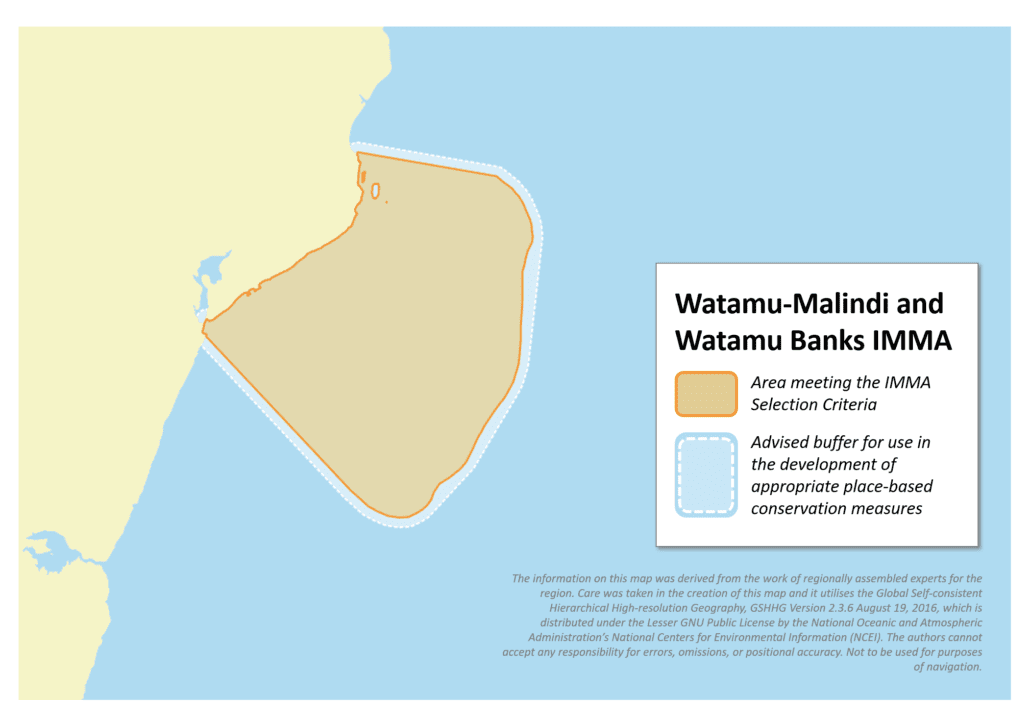
Size in Square Kilometres
951
Qualifying Species and Criteria
Indo-pacific bottlenose dolphin – Tursiops aduncus
Criterion B (1)
Humpback whale – Megaptera novaeangliae
Criterion C (3b)
Criterion D (2) – Marine Mammal Diversity
Other Marine Mammal Species Documented
Balaenoptera edeni, Globicephala macrorhynchus, Orcinus orca, Physeter macrocephalus, Pseudorca crassidens, Sousa plumbea, Stenella longirostris
Summary
Watamu – Malindi is located in the rich, shallow coastal waters off north-central Kenya and includes the Watamu Banks, a large nearshore banks system known for its world class sport-fishing. A long-term photo-identification study shows that Indo Pacific bottlenose dolphins (Tursiops aduncus) are resident in the area, with mothers and calves frequently observed in the nearshore waters of the Watamu Marine National Park. Endangered Indian Ocean humpback dolphins (Sousa plumbea) are also present in the area, although they are less well-studied. The Watamu Banks also host humpback whales (Megaptera novaeangliae) belonging to the Southern Hemisphere population labelled ‘Breeding Stock C’ by the International Whaling Commission. Whales migrate through the IMMA between July and October each year, and observations between 2014 and 2016 included mothers and calves.
Description of Qualifying Criteria
Criterion A – Species or Population Vulnerability
Criterion B – Distribution and Abundance
Sub-criterion B1 – Small and Resident Populations
A resident population of Indo-Pacific bottlenose dolphins (Tursiops aduncus) has been observed to use the area and this is evident from photo-ID data based on surveys conducted from 2010 to date (Mwang’ombe et al. 2015). Studies were conducted from 2011-2014, including 101 dedicated boat-based surveys between November and April, in 71 km2 of the Watamu area during the northeast monsoon season from 2011-2014. Search effort covered 951 km resulted in 92 sighting records of Indo-Pacific bottlenose dolphins. From 2010 to 2019, 141 individual Indo Pacific bottlenose dolphins have been photo-identified in this area with a high re-sighting rate suggesting residency. The encounter rate for the 2011 – 14 period for this species was 0.156 sightings/km2. The distribution of Indo-Pacific bottlenose dolphins that occur inside the Watamu-Malindi and Watamu Banks area shows a strong preference for the reefs inside the MPA, where they feed on inshore reef fish. This long-term photo-identification program has been conducted in Watamu since 2010 and this demonstrates that the population of Indo-pacific bottlenose dolphins is resident in Watamu where mother-calf pairs are frequently sighted in the coastal zone. The Watamu Banks are a very well-known sport fishing area and has many record-breaking catches of game fish.
Sub-criterion B2 – Aggregations
Criterion C: Key Life Cycle Activities
Sub-criterion C1 – Reproductive Areas
Sub-criterion C2: Feeding Areas
Sub-criterion C3: Migration Routes
C3a – Whale Seasonal Migratory Route
C3b – Migration / Movement Area
The Watamu banks is an important area for breeding and migrating humpback whales (Megaptera novaeangliae), and the Kenya Marine Mammal Network, which logs all citizen science whale sightings, has more records from the Watamu Banks than from any other location. Although this is biased by effort, it is clear that the Watamu Banks is an important area for migrating and breeding humpback whales. Land-based observations of humpback whales have been made from a fixed land position on a headland near Watamu from an elevation of 29m with a 180-degree view of the sea. Surveys were conducted 4 days a week for a 5-hour period per day (Mwang’ombe et al. 2015). In 2014 land-based surveys recorded 54 sightings of humpback whale (Megaptera novaeangliae), which was the highest encounter rate (ER =0.51/hour) compared to 2015 and 2016 (ER = 0.17/hour). Calves were sighted in 2014, 2015 and 2016.
Criterion D – Special Attributes
Sub-criterion D1 – Distinctiveness
Sub-criterion D2 – Diversity
Supporting Information
Mwang’ombe, M.G., Pérez-Jorge, S., Charo, K.K., Yaa, J.K., Njuguna, L.N., Trott, S.J. & Spilsbury, J.H. (2015) Cetacean species distribution and encounter rates in the Malindi – Watamu National Marine Reserve 2011 – 2014. Poster presented at the. In Western Indian Ocean Marine Science Association, Durban, South Africa.
Mwang’ombe, M.G., Pérez-Jorge, S., Charo, K.K., Yaa, J.K., Njuguna, L.N., Trott, S.J. & Spilsbury, J.H. (2017) Improving understanding of whales migration through the Kenyan Inshore waters. Poster presented at the. In Western Indian Ocean Marine Science Association, Dar-es-salaam, Tanzania.
Downloads
Download the full account of the Watamu-Malindi and Watamu Banks IMMA using the Brochure button below:
To make a request to download the GIS Layer (geopackage and/or geojson) for the Watamu-Malindi and Watamu Banks IMMA please complete the following Contact Form: