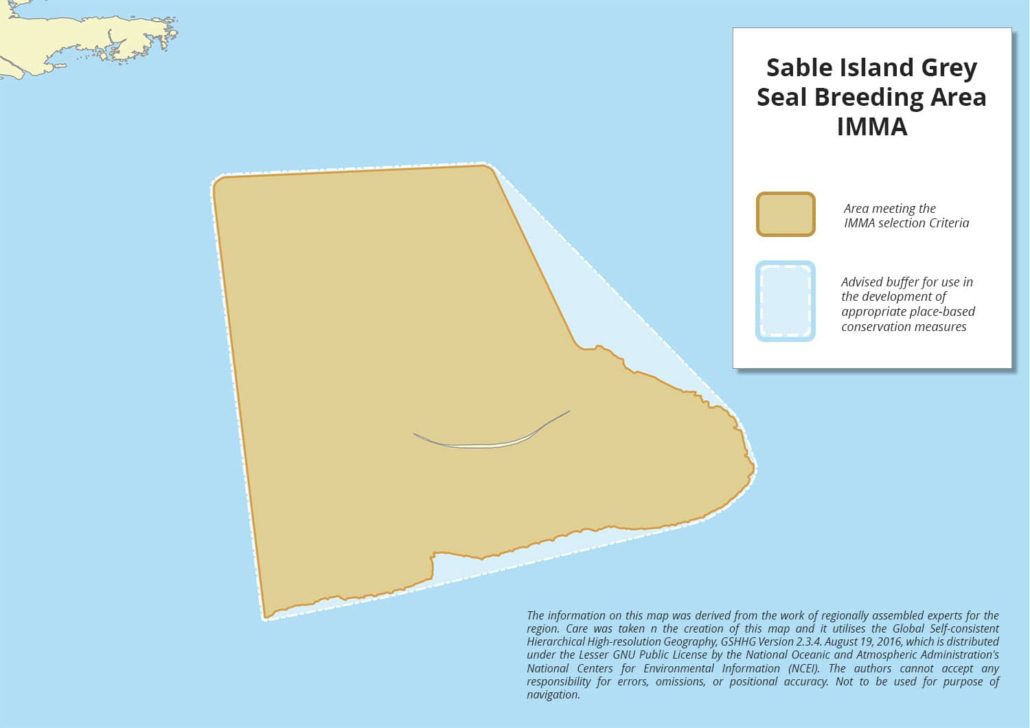
Size in Square Kilometres
15072
Qualifying Species and Criteria
Grey Seal – Halichoerus grypus
Criterion B (2); C (1)
Criterion D (2) – Marine Mammal Diversity
Other Marine Mammal Species Documented
Summary
The largest grey seal (Halichoerus grypus) breeding colony in the world is on Sable Island, a 40 km long crescent-shaped sandbar located approximately 300 km east southeast of Halifax Nova Scotia. The island is also an important haul-out area for grey seals during the non-breeding period of the year. Grey seals use the island for breeding, raising their pups, moulting and resting between foraging trips, which extend over portions of the Scotian Shelf.
Description of Qualifying Criteria
Criterion A – Species or Population Vulnerability
Criterion B – Distribution and Abundance
Sub-criterion B1 – Small and Resident Populations
Sub-criterion B2 – Aggregations
Sable Island is a crescent shaped partially vegetated sandbar approximately 42 km long located along the outer edge of the Scotian Shelf, approximately 300 km east of Halifax, Nova Scotia (Mosnier et al 2023; Hamilton et al. 2023; Lidgard et al 2023). The island has long been known as an important haul-out area for Northwest Atlantic grey seals (Halichoerus grypus) (Mansfield and Beck 1977; Rossi et al. 2021). A series of aerial surveys flown in eastern Canada during the summers of 2019-2021 counted hauled-out grey seals. The surveys covered the entire Canadian Atlantic coast south of 51.5 ° N, including the Gulf of St Lawrence. A total of 41,000 grey seals were counted, of which 22,000 were hauled-out on Sable Island. Global comparisons in abundance are complicated by differences in assessment methodologies and dispersal (breeding season pup surveys vs post breeding adult haulout counts). However, with a summer count of 22,000, Sable Island must be regarded as a globally major non-breeding grey seal haul-out area.
Criterion C: Key Life Cycle Activities
Sub-criterion C1 – Reproductive Areas
Grey seals breed on a variety of substrates including pack ice and sandy or rocky shores of isolated islands (den Heyer et al. 2020). Sable Island provides a secure haul-out area for grey seal reproduction and for resting outside of the breeding season. The animals generally forage on the Scotian Shelf, preferably in areas where water depths are less than 100m deep and within 100 km of the island (Breed et al 2006,2009, 2013). In Canada pupping occurs during December-February. The Canadian grey seal total population has increased from roughly 10,000 animals in the early 1960s to current estimates of 366,400 animals (Hammill et al 2023). Using pup production as an index of abundance, the estimated global pup production is 192,150 animals of which 87,500 or 46% of the global total are born on Sable Island, making it the largest grey seal pupping colony in the world (Table 4 in NERC-SCOS 2022; den Heyer et al 2020).
Sub-criterion C2: Feeding Areas
Sub-criterion C3: Migration Routes
C3a – Whale Seasonal Migratory Route
C3b – Migration / Movement Area
Criterion D – Special Attributes
Sub-criterion D1 – Distinctiveness
Sub-criterion D2 – Diversity
Supporting Information
Austin, D., W.D. Bowen, J.I. McMillan and S.J. Iverson. 2006. Linking movement, diving and habitat to foraging success in a large marine predator. Ecology 87:3095-310.
Breed, G.A., I.D. Jonsen, R.A. Myers, W.D. Bowen and M.L. Leonard.2009. Sex-specific, seasonal foraging tactics of adult grey seals (Halichoerus grypus) revealed by state-space analysis. Ecology 90:3209-3221.
Breed, G.A., W.D. Bowen and M.L. Leonard. 2013. Behavioral signature of intraspecific competition and density dependence in colony-breeding marine predators. Ecology and Evolution 2013; 3(11): 3838–3854.
Breed, G.A., W.D.Bowen, J.I. McMillan and M.L. Leonard. 2006. Sexual segregation of seasonal foraging habitats in a non-migratory marine mammal. Proc.R.Soc.273:2319-2326.
den Heyer, C.E., W.D. Bowen, J. Dale, J-F. Gosselin, M.O. Hammill, D.W. Johnston, S.L.C. Lang, K. Murray, G.B. Stenson, and S.A. Wood. 2020. Contrasting trends in gray seal (Halichoerus grypus) pup production 1 throughout the increasing northwest Atlantic metapopulation. Marine Mammal Science. DOI: 10.1111/mms.12773
Hammill, M.O., Rossi, S.P., Mosnier, A., den Heyer, C.E., Bowen, W.D., and Stenson, G.B. 2023. Grey Seal Abundance in Canadian Waters and Harvest Advice. DFO Can. Sci. Advis. Sec. Res. Doc. 2023/053. iv + 40 p.
Hamilton C.D., Goulet, P.J., Stenson, G.B., and Lang, S.L.C. 2023. Counts and spatial distribution of harbour seals (Phoca vitulina) and grey seals (Halichoerus grypus) from an aerial survey of the coast of the Newfoundland Shelf and Sandwich Bay, Labrador during the summer of 2021. Can. Tech. Rep. Fish. Aquat. Sci. 3566 : v + 39 p.
Lidgard D, Dispas A, Mosnier A, Varkey P, Kehler D, den Heyer C (2023) Distribution and counts of harbour (Phoca vitulina) and grey seals (Halichoerus grypus) on the Atlantic coast of Nova Scotia and Bay of Fundy from aerial and land surveys, 2019-2021. Can. Tech. Rep. Fish. Aquat. Sci. 3569: v + 88 p.
Mansfield, A. W., and Beck, B. 1977. The grey seal in Eastern Canada. Fisheries and Marine Service Technical Report, 704: 1–81.
Mosnier, A., Dispas, A., and Hammill, M.O. 2023. Spatial distribution and count of harbour seals (Phoca vitulina) and grey seals (Halichoerus grypus) in the Estuary and Gulf of St. Lawrence from an aerial survey conducted in June 2019. Can. Tech. Rep. Fish. Aquat. Sci. 3541 : v + 60 p.
Natural Environment Research Council Special Committee on Seals (NERC-SCOS). 2022. Scientific Advice on Matters Related to the Management of Seal Populations. 206 p. Scientific Advice on Matters Related to the Management of Seal Populations: 2022 (st-andrews.ac.uk)
Rossi, S. P., Cox, S. P., Hammill, M. O., den Heyer, C. E., Swain, D. P., Mosnier, A., and Benoıˆt, H. P. 2021. Forecasting the response of a recovered pinniped population to sustainable harvest strategies that reduce their impact as predators. – ICES Journal of Marine Science 78(5), 1804– 1814.
Smith, P. C., B. Petrie, B. and C.R. Mann. 1978. Circulation, variability, and dynamics of the Scotian Shelf and Slope. J. Fish. Res. Board Can. 35: 1067-1083.
Downloads
Download the full account of the Sable Island Grey Seal Breeding Area IMMA using the Brochure button below:
To make a request to download the GIS Layer (geopackage and/or geojson) for the Sable Island Grey Seal Breeding Area IMMA please complete the following Contact Form: