Size in Square Kilometres
29394
Qualifying Species and Criteria
Guiana Dolphin – Sotalia guianensis
Criterion A; B (2); C (2)
Greater Caribbean Manatee – Trichechus manatus manatus
Criterion A; C (1, 2)
Criterion D (2) – Marine Mammal Diversity
Other Marine Mammal Species Documented
Tursiops truncatus
Summary
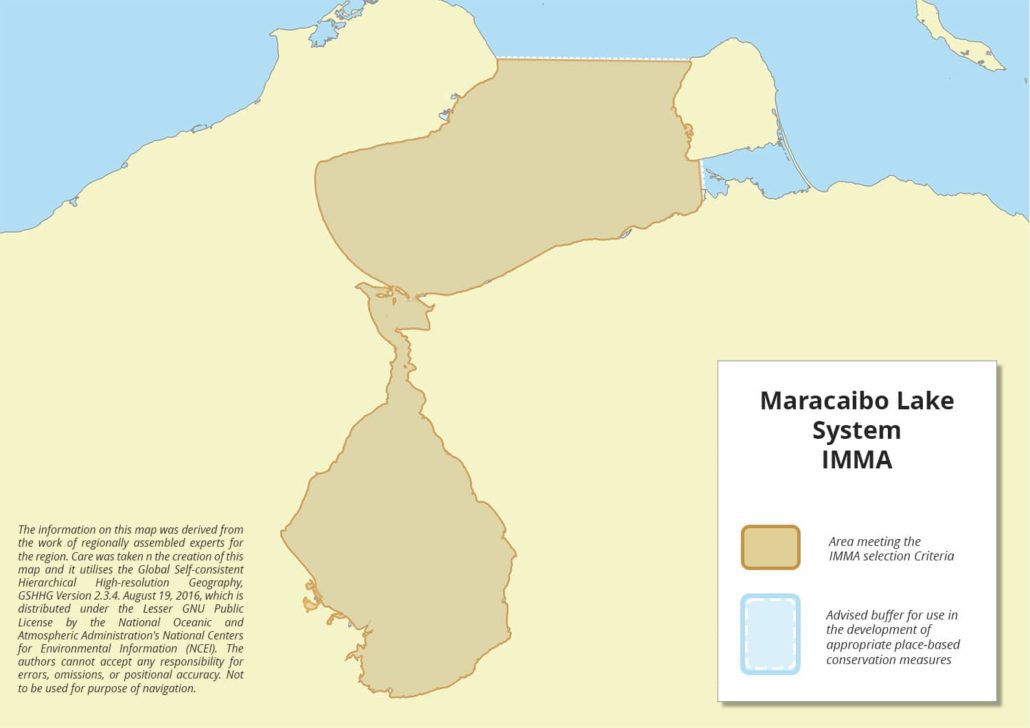
The Maracaibo Lake System is located on the southwestern coast of Venezuela, adjacent to the border with Colombia. The system includes the marine waters of the Gulf of Venezuela, the estuarine waters of the Bahía el Tablazo and the strait, and the waters of the lake of Maracaibo. The area includes shallow waters up to 55 m deep, and several species assemblages from plants to fish, and others. The IMMA hosts Endangered Antillean/Greater Caribbean manatees (Trichechus manatus manatus), and Near-Threatened Guiana dolphins (Sotalia guianensis). Observations of mating and the presence of manatee mothers and calves have been widely documented throughout the year. At least four feeding areas have been identified for the Guiana dolphin, including the mouths of the Catatumbo and Chama rivers, Barranquitas, and the southern Gulf of Venezuela. The system includes the Ciénaga de los Olivitos Wildlife Refuge in the southeastern portion of the Gulf of Venezuela, the Ciénaga de la Palmita and Isla de Pájaros Wildlife Reserve in the strait, and the Ciénagas de Juan Manuel Aguas Blancas y Aguas Negras National Park in the southwestern Lake of Maracaibo.
Description of Qualifying Criteria
Criterion A – Species or Population Vulnerability
The West Indian manatee (Trichechus manatus) is red-listed globally as Vulnerable (Deutsch et al., 2008), while the Antillean, or Greater Caribbean subspecies (Trichechus manatus manatus) is listed as Endangered (Morales et al. 2024). At the national level in Venezuela, the species is considered Critically Endangered, with a population decimated by hunting, bycatch, and habitat loss and degradation (Boede et al., 2015)
The Guiana or “costero” dolphin (Sotalia guianensis) is red-listed as Near Threatened (Secchi et al., 2018) but as Vulnerable nationally (Barrios-Garrido et al., 2015). In the Maracaibo Lake System, the Guiana dolphin faces particular threats from bycatch and direct hunting, with annual removals of almost 200 individuals (Briceño et al., 2021; Sánchez et al., 2017).
Criterion B – Distribution and Abundance
Sub-criterion B1 – Small and Resident Populations
Sub-criterion B2 – Aggregations
Small boat surveys in the IMMA have yielded records of several groups of Guiana dolphins in the navigation channel (north Maracaibo Lake) with densities as high as 150 individuals in about 7km2(Espinoza-Rodríguez et al. 2019). Strong winds, sea-surface temperatures around 25 C, and moderate concentrations of chlorophyll support a significant prey-base of different species of fish that can move in or out the area (Espinoza-Rodríguez et al. 2019). The species is also found in southern portions of Lake Maracaibo with a reported estimated abundance of up to 200 individuals (Briceño et al, 2017).
Criterion C: Key Life Cycle Activities
Sub-criterion C1 – Reproductive Areas
Records of manatee mothers with calves are frequent both in the northern and southern sides of the lake throughout the year, including the Ciénaga de la Palmita and Isla de Pájaros Wildlife Reserve in the north, and the Birimbay Lagoon in the southwest (Briceño et al., 2024b). Although not direct observations of mating have been recorded, recent research has conducted a total of 407.14 hours of manatee visual surveys recording 18 direct sightings of manatees with an average RIA of 0.068 sightings per hour (Manzanilla-Fuentes et al. 2024).
Sub-criterion C2: Feeding Areas
The lake’s environmental conditions (freshwater sources, shallow and calm areas) and patches of Ruppia maritima and Regnellidium diphyllum provide ideal feeding habitat for manatees (Briceño et al., 2024b; Manzanilla-Fuentes et al. 2024).
At least four feeding Guiana dolphin feeding areas have been identified in the IMMA, including the mouth of the Catatumbo River, Chama River, Barranquitas, and the southern Gulf of Venezuela, respectively. Feeding was the predominant behaviour recorded in at least 75% of the dolphin observations (on average 300 to 800 sightings in different sites both north and south of the system). Groups of between 10 and 200 individuals have been observed in feeding behaviour, with fast movements, aerial activity, and herding of prey (De Turris et al., 2010; Espinoza-Rodríguez et al.,2015; Briceño et al, 2017; 2024a).
Sub-criterion C3: Migration Routes
C3a – Whale Seasonal Migratory Route
C3b – Migration / Movement Area
Criterion D – Special Attributes
Sub-criterion D1 – Distinctiveness
Sub-criterion D2 – Diversity
Supporting Information
Barrios-Garrido, H., Boher-Bentti, S., De Turris-Morales, K., Espinoza, N., Ferrer-Pérez, A., Herrera-Trujillo, O. L., León, T., Oviedo, L., Pirela, D., Portocarrero-Aya, M., Sánchez-Criollo, L., Trujillo, F. y Bolaños-Jiménez, J. 2015. Tonina costera, Sotalia guianensis. En: J.P. Rodríguez, A. García-Rawlins y F. Rojas-Suárez (eds.) Libro Rojo de la Fauna Venezolana. Cuarta edición. Provita y Fundación Empresas Polar, Caracas, Venezuela. Available at: http://animalesamenazados.provita.org.ve/content/tonina-costera
Boede, E. O., Ferrer-Pérez, A., Manzanilla Fuentes, A. G., Trujillo, F., Hernández, O., Jedrzejewski, W. y
Barros, T. (2015). Manatí, Trichechus manatus. En: J.P. Rodríguez, A. García-Rawlins y F. Rojas-Suárez (eds.) Libro Rojo de la Fauna Venezolana. Cuarta edición. Provita y Fundación Empresas Polar, Caracas, Venezuela.
Briceño, Y., Sánchez, L., Herrera, O., Stachowicz, I. 2017. Group size and composition of Sotalia guianensis in southern of Maracaibo Lake, Venezuela. SCB’s 28th International Congress for Conservation Biology (ICCB 2017).
Briceño, Y., Sánchez, L., Trujillo, F., von Fersen, L., & Ramírez, S. (2021). Aquatic Wildmeat Consumption of Guiana Dolphins (Sotalia guianensis) in Lake Maracaibo System, Venezuela. Frontiers in Marine Science, 8, 625801.
Briceño, Y., Sánchez, L. 2022. Informe técnico sobre capturas incidentales, cacería y aprovechamiento de la tonina del lago (Sotalia guianensis) y el manatí (Trichechus manatus manatus) en el lago de Maracaibo. Instituto Nacional de Parques Nacionales (Inparques) 23pp.
Briceño, Y., Sánchez, L., Viloria, A., Trujillo, F. (2024a). Ecological Aspects of Sotalia guianensis in the south of Lake Maracaibo: Evaluation of the Current State of Conservation”.
Briceño, Y., Sánchez, L., Viloria, A., von Fersen, L. (2024b). Occurrence of the Antillean manatee (Trichechus manatus manatus) in the Ciénaga la Palmita e Isla de Pájaros Wildlife Refuge, northeast of Lake Maracaibo.
Briceño, Y. A Capítulo II. Sotalia guianensis pag 18. Autor ficha técnica en Ferrer, A., Herrera, O., Trujillo, F., Mosquera-Guerra, F., de La Cruz Melo, G., Lew, D., … & Usma, S. (2017). Plan de acción para la conservación de los mamíferos acuáticos de Venezuela: delfines de agua dulce, nutrias y manatíes 2017-2027. Caracas, Venezuela.
Caballero, S., Trujillo, F., Vianna, J. A., Barrios‐Garrido, H., Montiel, M. G., Beltrán‐Pedreros, S., … & Baker, C. S. (2007). Taxonomic status of the genus Sotalia: species level ranking for “tucuxi” (Sotalia fluviatilis) and “costero” (Sotalia guianensis) dolphins. Marine Mammal Science, 23(2), 358-386.
Caballero, S., Hollatz, C., Rodríguez, S., Trujillo, F., & Baker, C. S. (2018). Population structure of riverine and coastal dolphins Sotalia fluviatilis and Sotalia guianensis: nuclear and mitochondrial diversity patterns and implications for conservation. Journal of Heredity, 109(7), 757-770.
De Turris-Morales, K., Delgado-Ortega, G., Espinoza-Rodríguez, N. Montiel-Villalobos, M.G., Barrios-Garrido, H. 2010. Nota sobre el comportamiento alimenticio del delfín estuarino (Sotalia guianensis) en la costa occidental del lago de Maracaibo (notes on the estuarine dolphin (Sotalia guianensis) feeding behavior on the coast western of Maracaibo lake). ECOTRÓPICOS 23(2):114-116 2010
Deutsch, C.J., Self-Sullivan, C. & Mignucci-Giannoni, A. 2008. Trichechus manatus. The IUCN Red List of Threatened Species 2008: e.T22103A9356917. http://dx.doi.org/10.2305/IUCN.UK.2008.RLTS.T22103A9356917.en
Domit, C., Caballero, S., Miranda, A., Fruet, P., Torres-Florez, J. P., Cunha, H., … & Andriolo, A. (2021). Report of the Sotalia guianensis pre-assessment workshop: main results and status of the current knowledge. IWC Scientific Committee. J Cetacean Res Manag (suppl.), 22, 333-378.
Espinoza-Rodríguez, Carrasquero, J., De Turris-Morales, K., Barrios-Garrido, H. 2015. Asociaciones entre aves marinas y Sotalia guianensis en el sur del golfo de Venezuela. Seabirds and Sotalia guianensis associations at the southern Gulf of Venezuela. Caldasia, 37(2): 309-318.
Espinoza Rodríguez N, De Turris-Morales K & Barrios-Garrido H. 2019a. Descripción craneométrica de cinco individuos del delfín nariz de botella Tursiops truncatus Montagu, 1821 (Cetartiodactyla: Delphinidae) presentes en las costas del Golfo de Venezuela. Ecotrópicos 31:e0007.
Espinoza-Rodríguez, N., De Turris-Morales, K., Shimada, T. and Barrios-Garrido, H. 2019b. Guiana dolphin (Sotalia guianensis) in the southern Gulf of Venezuela: Seasonal distribution, group size, and habitat use. Regional Studies in Marine Science, 32: 100874. https://doi.org/10.1016/j.rsma.2019.100874
Manzanilla-Fuentes, A., de Villasmil, A.V.P., Castelblanco-Martínez, N., Hernández, J.; Seijas, A. E., &; Moreno-Arias, R. 2024. The Antillean manatee in the north of Maracaibo Lake (Venezuela): distribution, and conservation issues. Acta Biológica Colombiana, 29(1), 41-48. https://doi.org/10.15446/abc.v29n1.98212
Morales-Vela, B., Quintana-Rizzo, E. & Mignucci-Giannoni, A. 2024. Trichechus manatus ssp. manatus. The IUCN Red List of Threatened Species 2024: e.T22105A43793924. Accessed on 20 November 2024.
Rodríguez G. 2000. Fisiografía del Sistema de Maracaibo. In: Rodríguez, G (Ed.) El Sistema de Maracaibo, 2da. Edición. Instituto Venezolano de Investigaciones Científicas (IVIC), Caracas, Venezuela, pp. 7–19.
Rossi-Santos, M. R., Wedekin, L. L., & Monteiro-Filho, E. D. A. (2010). Habitat use of the Guiana dolphin, Sotalia guianensis (Cetacea, Delphinidae), in the Caravelas River estuary, eastern Brazil. Latin American Journal of Aquatic Mammals, 111-116.
Sánchez, L. Briceño Y, Stachowicz, I. 2017. Anthropogenics interactions increasing mortality of cetaceans in the Maracaibo Lake, Venezuela. SCB’s 28th International Congress for Conservation Biology (ICCB 2017).
Secchi, E., Santos, M.C. de O. & Reeves, R. 2018. Sotalia guianensis (errata version published in 2019). The IUCN Red List of Threatened Species 2018: e.T181359A144232542. https://dx.doi.org/10.2305/IUCN.UK.2018-2.RLTS.T181359A144232542.en
Downloads
Download the full account of the Maracaibo Lake System IMMA using the Brochure button below:
To make a request to download the GIS Layer (geopackage and/or geojson) for the Maracaibo Lake System IMMA please complete the following Contact Form: