Size in Square Kilometres
9004
Qualifying Species and Criteria
Florida manatee – Trichechus manatus latirostris
Criterion A; B (2)
Common bottlenose dolphin – Tursiops truncatus
Criterion B (1)
Criterion D (2) – Marine Mammal Diversity
Other Marine Mammal Species Documented
Tursiops erebennus
Summary
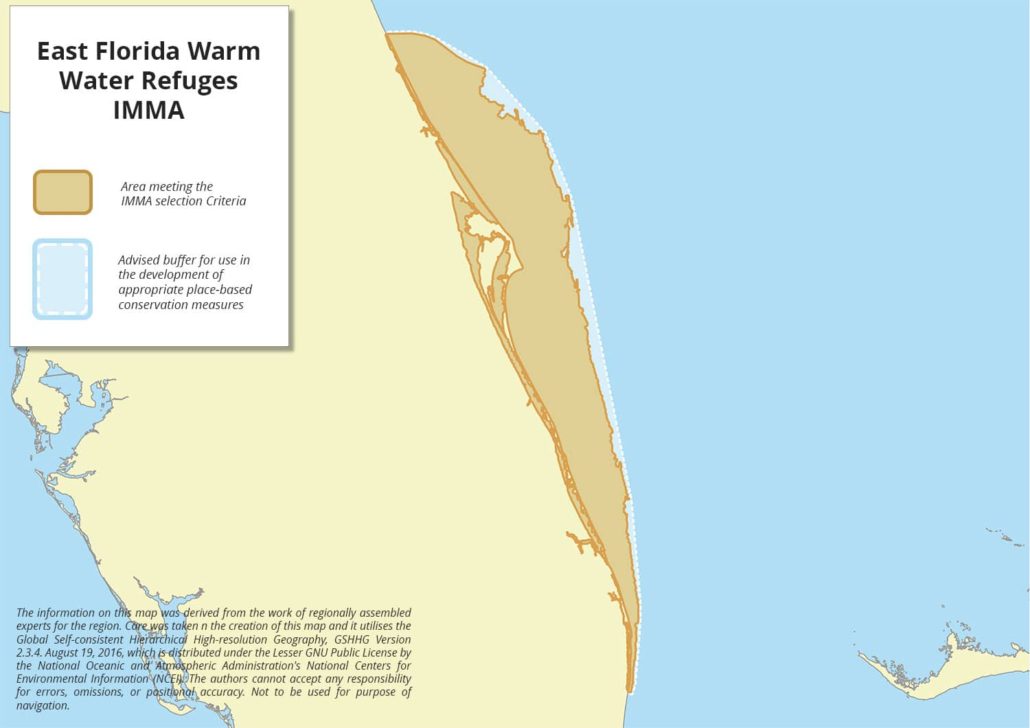
The East Florida Warm Water Refuges IMMA includes numerous discrete areas and the interconnected seagrass beds and shallow inland waterways along the Atlantic coast of Florida in the continental United States. The IMMA includes coastal waters extending to the 25 m isobath line along the coastline. This IMMA also includes inlets and bays, thermal basins, springs, creeks, dredged canals, and warm-water discharge sites of power plants where waters typically remain above 20°C. These warm water refuges and seagrass beds provide important wintering habitat and feeding grounds for Endangered Florida Manatees (Trichechus manatus latirostris). The IMMA also provides habitat that supports resident populations of coastal bottlenose dolphins, which are predominantly common bottlenose dolphins (Tursiops truncatus), but may include the newly described Tamanend’s bottlenose dolphin (Tursiops erebennus). There are a variety of protected areas across the region, some designated specifically for protecting Florida manatees, including Blue Springs State Park, and power plant warm water outfalls.
Description of Qualifying Criteria
Criterion A – Species or Population Vulnerability
The West Indian Manatee (Trichechus manatus) as a species is listed as Endangered on the IUCN Red List of Threatened Species (Deutsch and Morales-Vela 2024). The Florida Manatee (Trichechus manatus latirostris) is a sub-species of the West Indian manatee that has not yet been assessed by the IUCN Red List.
Criterion B – Distribution and Abundance
Sub-criterion B1 – Small and Resident Populations
The IMMA includes the Indian River Lagoon, one of the largest stocks of BSE (Bays, Sounds and Estuaries) stocks of common bottlenose dolphins (Tursiops truncatus) in the southeastern U.S. The best available population estimate is 1,032 individuals (95% CI 969-1,98; CV=0.03; Durden et al., 2021). Long-term residency has been documented through decades of photo-identification studies in the Indian River Lagoon (Odell and Asper, 1990; Titcomb et al., 2015), although movements outside of the lagoon are frequent (Odell and Asper, 1990). However, it is clear that the population in the lagoon is distinct from neighbouring coastal stocks (Mazzoil et al., 2011). Multiple communities of bottlenose dolphins are present, but more research is needed to understand the movements and fine-scale community structure within the area (Titcomb et al., 2015).
Sub-criterion B2 – Aggregations
Aerial surveys to estimate abundance of manatees in Florida conducted in 2021-2022 (https://myfwc.com/research/manatee/research/population-monitoring/synoptic-surveys/) yielded an estimate of 9,790 of which 3,060-4,280 occurred on the east coast of Florida within the waters of the IMMA (Gowan et al., 2023). Manatees are vulnerable to cold stress and death, thus their survival depends on the use of warm-water refuges resulting from discharge of power plants and passive thermal basins, springs, creeks, and dredged canals, particularly in inland freshwater bodies, and on the presence of seagrass meadows (Laist et al., 2013; Valade et al., 2020). Long-term monitoring through aerial surveys indicates the presence of aggregations (50 to more than 500) of Florida manatees at key wintering sites in the IMMA (Laist and Reynolds, 2005; Laist et al., 2013) including St Johns River, Cape Canaveral, Port Everglades and Blue Springs State Park (Deutsch et al., 2003; Martin et al., 2015; Gowan et al., 2023). These areas serve as winter aggregation sites for more than half of the east coast population and serve as the primary feeding habitats for the east coast population of the subspecies (Laist et al., 2013; Gowan et al., 2023; Valade et al., 2020). Martin et al. (2015) estimated that 70% of the east coast manatee population were in Brevard County during a coast-wide survey in March 2012. Along the coastline, extensive seagrass meadows provide the main feeding grounds for this species. Manatees primarily forage on Halodule wrightii and Syringodium filiforme, which are concentrated in intracoastal waters around the State, from the Indian River Lagoon to the Florida Keys (east to south), (Zieman & Zieman, 1989; Allen et al. 2022).
Criterion C: Key Life Cycle Activities
Sub-criterion C1 – Reproductive Areas
Sub-criterion C2: Feeding Areas
Sub-criterion C3: Migration Routes
C3a – Whale Seasonal Migratory Route
C3b – Migration / Movement Area
Criterion D – Special Attributes
Sub-criterion D1 – Distinctiveness
Sub-criterion D2 – Diversity
Supporting Information
Allen, A. C., Beck, C. A., Sattelberger, D. C. & Kiszka, J. J. (2022). Evidence of a dietary shift by the Florida manatee (Trichechus manatus latirostris) in the Indian River Lagoon inferred from stomach content analyses. Estuarine, Coastal and Shelf Science, 268, 107788.
Deutsch, C.J. & Morales-Vela, B. 2024. Trichechus manatus. The IUCN Red List of Threatened Species 2024: e.T22103A43792740. https://dx.doi.org/10.2305/IUCN.UK.2024-2.RLTS.T22103A43792740.en. Accessed on 21 January 2025.
Deutsch CJ, Reid JP, Bonde RK, Easton DE, et al. 2003. Seasonal movements, migratory behavior, and site fidelity of West Indian manatees along the Atlantic coast of the United States. Wildl Monogr. 151:1–77.
Durden, W.N., E.D. Stolen, T. Jablonski, L. Moreland, E. Howells, A. Sleeman, M. Denny, G. Biedenbach and M. Mazzoil. 2021. Abundance and demography of common bottlenose dolphins (Tursiops truncatus truncatus) in the Indian River Lagoon, Florida: A robust design capture-recapture analysis. PLoS ONE 16(4):e0250657.
Gowan TA, Edwards HH, Krzystan AM, Martin J, Hostetler JA. 2023. 2021-2022 Statewide Abundance Estimates for the Florida Manatee. Florida Fish and Wildlife Conservation Commission, Fish and Wildlife Research Institute Technical Report No. 27.
Laist, D. W., & Reynolds III, J. E. (2005). Influence of power plants and other warm‐water refuges on Florida manatees. Marine Mammal Science, 21(4), 739-764.
Laist, D. W., Taylor, C., & Reynolds III, J. E. (2013). Winter habitat preferences for Florida manatees and vulnerability to cold. PLoS One, 8(3), e58978.
Martin, J., Edwards, H. H., Fonnesbeck, C. J., Koslovsky, S. M., Harmak, C. W., & Dane, T. M. (2015). Combining information for monitoring at large spatial scales: first statewide abundance estimate of the Florida manatee. Biological Conservation, 186, 44-51.
Mazzoil, M., M.E. Murdoch, E. Howells, S. Bechdel, M. deSieyes, J.S. Reif, G.D. Bossart and S.D. McCulloch. 2011. Site fidelity and movement of bottlenose dolphins (Tursiops truncatus) on Florida’s east coast: Atlantic Ocean and Indian River Lagoon estuary. Fla. Sci. 74: 25–37.
Odell, D.K. and E.D. Asper. 1990. Distribution and movements of freeze-branded bottlenose dolphins in the Indian and Banana Rivers, Florida. Pages 515-540 in: S. Leatherwood and R. Reeves, (eds.) The bottlenose dolphin. Academic Press, San Diego, CA.
Valade, J., R. Mezich, K. Smith, M. Merrill and T. Calleson (editors). 2020 update. Florida Manatee Warm-Water Action Plan. U.S. Fish & Wildlife Service and Florida Fish and Wildlife Conservation Commission. 43pp.
Zieman, J.C. and Zieman, R.T., 1989. The ecology of the seagrass meadows of the west coast of Florida: a community profile (Vol. 85, No. 7). US Department of the Interior, Fish and Wildlife Service, Research and Development.
Downloads
Download the full account of the East Florida Warm Water Refuges IMMA using the Brochure button below:
To make a request to download the GIS Layer (geopackage and/or geojson) for the East Florida Warm Water Refuges IMMA please complete the following Contact Form: